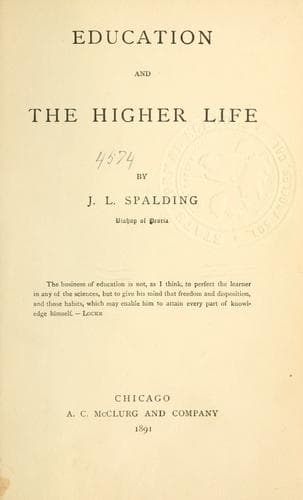
Education and the Higher LifeSpalding, John Lancaster
Religion
Education and the Higher Life
Spalding, John Lancaster
Education
Yet, if we make money and its equivalents a life-purpose--the aim and
end of our earthly hopes--our service becomes idolatry, and a blight
falls upon the nobler self. Money is the equivalent of what is
venal,--of all that may be bought or sold; but the best, the godlike,
the distinctively human, cannot be bought or sold. A rich man can buy a
wife, but not a woman's love; he can buy books, but not an appreciative
mind; he can buy a pew, but not a pure conscience; he can buy men's
votes and flattery, but not their respect. The money-world is visible,
material, mechanical, external; the world of the soul, of the better
self, is invisible, spiritual, vital. God's kingdom is within. What we
have is not what we are; and the all-important thing is to be, and not
to have. Our possessions belong to us only in a mechanical way. The
poet's soul owns the stars and the moonlit heavens, the mountains and
rivers, the flowers and the birds, more truly than a millionaire owns
his bonds. What I know is mine, and what I love is mine; and as my
knowledge widens and my love deepens, my life is enlarged and
intensified. But, since all human knowledge is imperfect and narrow, the
soul stretches forth the tendrils of faith and hope. Looking upon
shadows, we believe in realities; possessing what is vain and empty, we
trust to the future to bring what is full and complete.
All noble literature and life has its origin in regions where the mind
sees but darkly; where faith is more potent than knowledge; where hope
is larger than possession, and love mightier than sensation. The soul is
dwarfed whenever it clings to what is palpable and plain, fixed and
bounded. Its home is in worlds which cannot be measured and weighed. It
has infinite hopes, and longings, and fears; lives in the conflux of
immensities; bathes on shores where waves of boundless yearning break.
Borne on the wings of time, it still feels that only what is eternal is
real,--that what death can destroy is even now but a shadow. To it all
outward things are formal, and what is less than God is hardly aught. In
this mysterious, super-sensible world all true ideals originate, and such
ideals are to human life as rain and sunshine to the corn by which it is
nourished.
What hope for the future is there, then, when the young have no
enthusiasm, no heavenly illusions, no divine aspirations, no faith that
man may become godlike, more than poets have ever imagined, or
philosophers dreamed?--when money, and what money buys, is the highest
they know, and therefore the highest they are able to love?--when even
the ambitious among them set out with the deliberate purpose of becoming
the beggars of men's votes; of winning an office the chief worth of
which, in their eyes, lies in its emoluments?--when even the glorious
and far-sounding voice of fame for them means only the gabble and cackle
of notoriety?
Public-domain text, read in full here on John Shaqi.
Reviews
Reviews
No reviews yet
Be the first to share your thoughts on this work.
Join the Discussion
Join the discussion
Sign in to leave a comment or review.
Sign InorCreate an account