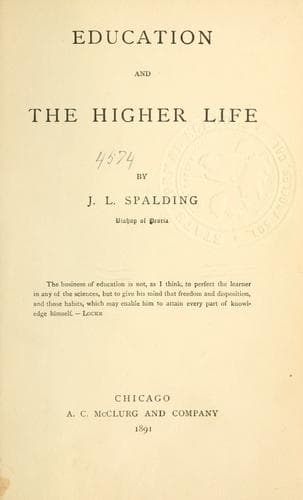
Education and the Higher LifeSpalding, John Lancaster
Religion
Education and the Higher Life
Spalding, John Lancaster
Education
value of what he learns is lost; for what leaves him unmoved, leaves him
unimproved. His information and accomplishments are comparatively
unimportant. What he himself is, and what his real self gives us grounds
for hoping he shall become, is the true concern. To be able to translate
AEschylus or Plato is not a great thing; but it is a great thing to have
the Greek's sense of what is fair, noble and intellectual. To be able to
solve a complex mathematical problem may be unimportant; but to have the
mental habit of accurate, close, patient thinking is important. It is
easy to forget one's Greek or the higher mathematics; but an
intellectual or a moral habit is not easily lost.
He who has right habits will go farther and rise higher than he who has
only brilliant attainments. It is an error, and a very common one, to
suppose that education is merely, or chiefly, a mental process, and
consequently that the best school is that in which the various kinds of
knowledge are best taught. Our whole being, physical, intellectual, and
moral, is subject to the law of education. We may educate the eye, the
ear, the hand, the foot; and each member of the body may be trained in
many ways. The eye of the microscopist has received a training different
from that of the painter; the sculptor's hand has been taught a cunning
unlike that of the surgeon; the voice of the orator is developed in one
way, that of the singer in another. And so the faculties of the mind may
be drawn forth, and each one in various ways. The powers of observation,
of reflection, of intuition, of imagination, are all educable. One of
the most important and most difficult lessons to learn is that of
attention. We know only what we are conscious of, and we are conscious
only of that to which we give heed. If we but hold the mind to any
subject with perseverance, it will deliver its secret. The little
knowledge we have is often vague and unreal, because we are heedless,
because we have never taught ourselves to dwell in conscious communion
with the objects of thought. The trained eye sees innumerable beauties
which are hidden from others, and so the mind which is taught to look
right sees truths the uneducated can never know. We may be taught to
judge as well as to look. Indeed, once we have learned to see things as
they are, correct opinions and judgments naturally follow. All faculty
is the result of education. Poets, orators, philosophers, and saints
bring not their gifts into the world with them; but by looking and
thinking, doing and striving, they rise from the poor elements of
half-conscious life to the clear vision of truth and beauty. Natural
endowments are not equal; but the chief cause of inequality lies in the
unequal efforts which men make to develop their endowments. The lack of
imagination in the multitude makes their life dull, uninteresting, and
material, and it is assumed that we are born with, or without,
imagination, and that there is no remedy for this misery. And those who
Public-domain text, read in full here on John Shaqi.
Reviews
Reviews
No reviews yet
Be the first to share your thoughts on this work.
Elsewhere in the archive
Join the Discussion
Join the discussion
Sign in to leave a comment or review.
Sign InorCreate an account