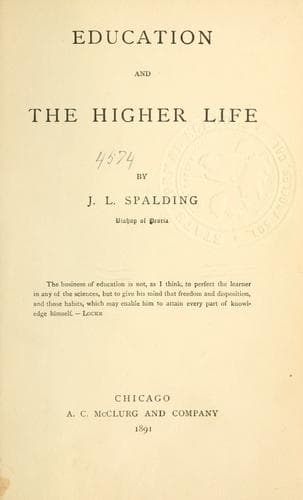
Education and the Higher LifeSpalding, John Lancaster
Religion
Education and the Higher Life
Spalding, John Lancaster
Education
We see the earth grow from a fire-ball to be the home of
man; we know its anatomy; we read its history; and we behold races of
animals which passed away ages before the eye of man looked forth upon
the boundless mystery and saw the shadow of the presence of the infinite
God. Better than the Greeks we know the history of Greece; than the
Romans that of Rome. Words that were never written have whispered to us
the dreams and hopes of people that perished and left no record; and the
more we have learned of the past the more clearly do we perceive how far
the present age surpasses all others in knowledge and in power.
The mighty movement by which this development has been caused, has not
slackened, but seems each day to gain new force; and the marvelous
changes, political, social, moral, intellectual, and physical, which
give character to the nineteenth century are but the prelude to a drama
which shall make all past achievements of our race appear weak and
contemptible. To imagine that our superiority is merely mechanical and
material is to fail to see things as they are. Greater individuals may
have lived than now are living, but never before has the world been
governed with so much wisdom and so much justice; and the power back of
our progress is intellectual, moral, and religious. Science is not
material. It is the product of intellect and will; and the great
founders of modern science, Copernicus, Kepler, Bacon, Descartes,
Galileo, Newton, Leibnitz, Ampere, Liebig, Fresnel, Faraday, and Mayer,
were Christians. "However paradoxical it may sound," says
DuBois-Reymond, "modern science owes its origin to Christianity."
Public-domain text, read in full here on John Shaqi.
Reviews
Reviews
No reviews yet
Be the first to share your thoughts on this work.
Elsewhere in the archive
Join the Discussion
Join the discussion
Sign in to leave a comment or review.
Sign InorCreate an account