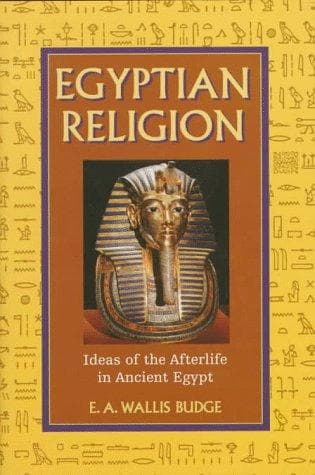
Egyptian Ideas of the Future LifeBudge, E. A. Wallis (Ernest Alfred Wallis), Sir
ReligionComparative
Egyptian Ideas of the Future Life
Budge, E. A. Wallis (Ernest Alfred Wallis), Sir
Egypt -- Religion; Eschatology, Egyptian; Future life
Next comes the question, "But who is this?" And the answer is: "It is
R[=a] when at the beginning he rose in the city of Suten-henen
(Heracleopolis Magna) crowned like a king in rising. The pillars of the
god Shu were not as yet created when he was upon the staircase of him
that dwelleth in Khemennu (Hermopolis Magna)." From these statements we
learn that Temu and R[=a] were one and the same god, and that he was the
first offspring of the god Nu, the primeval watery mass out of which all
the gods came into being. The text continues: "I am the great god Nu who
gave birth to himself, and who made his names to come into being and to
form the company of the gods. But who is this? It is R[=a], the creator
of the names of his members which came into being in the form of the
gods who are in the train of R[=a]." And again: "I am he who is not
driven back among the gods. But who is this? It is Tem, the dweller in
his disk, or as others say, it is R[=a] in his rising in the eastern
horizon of heaven." Thus we learn further that Nu was self-produced, and
that the gods are simply the names of his limbs; but then R[=a] is Nu,
and the gods who are in his train or following are merely
personifications of the names of his own members. He who cannot be
driven back among the gods is either Temu or R[=a], and so we find that
Nu, Temu, and R[=a] are one and the same god. The priests of Heliopolis
in setting Temu at the head of their company of the gods thus gave
R[=a], and Nu also, a place of high honour; they cleverly succeeded in
making their own local god chief of the company, but at the same time
they provided the older gods with positions of importance. In this way
worshippers of R[=a], who had regarded their god as the oldest of the
gods, would have little cause to complain of the introduction of Temu
into the company of the gods, and the local vanity of Heliopolis would
be gratified.
Public-domain text, read in full here on John Shaqi.
Reviews
Reviews
No reviews yet
Be the first to share your thoughts on this work.
Join the Discussion
Join the discussion
Sign in to leave a comment or review.
Sign InorCreate an account