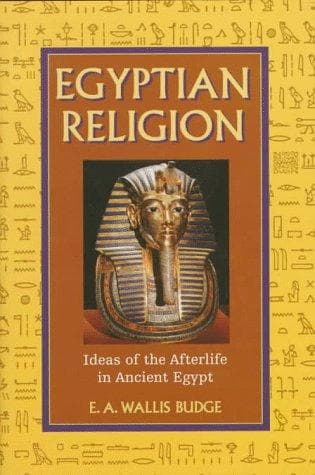
Egyptian Ideas of the Future LifeBudge, E. A. Wallis (Ernest Alfred Wallis), Sir
ReligionComparative
Egyptian Ideas of the Future Life
Budge, E. A. Wallis (Ernest Alfred Wallis), Sir
Egypt -- Religion; Eschatology, Egyptian; Future life
But besides the nine gods who were supposed to form the "great company"
of gods of the city of Heliopolis, there was a second group of nine gods
called the "little company" of the gods, and yet a third group of nine
gods, which formed the least company. Now although the _paut_ or company
of nine gods might be expected to contain nine always, this was not the
case, and the number nine thus applied is sometimes misleading. There
are several passages extant in texts in which the gods of a _paut_ are
enumerated, but the total number is sometimes ten and sometimes eleven.
This fact is easily explained when we remember that the Egyptians
deified the various forms or aspects of a god, or the various phases in
his life. Thus the setting sun, called Temu or Atmu, and the rising sun,
called Khepera, and the mid-day sun, called R[=a], were three forms of
the same god; and if any one of these three forms was included in a
_paut_ or company of nine gods, the other two forms were also included
by implication, even though the _paut_ then contained eleven, instead of
nine gods. Similarly, the various forms of each god or goddess of the
_paut_ were understood to be included in it, however large the total
number of gods might become. We are not, therefore, to imagine that the
three companies of the gods were limited in number to 9 x 3, or
twenty-seven, even though the symbol for god be given twenty-seven times
in the texts.
We have already alluded to the great number of gods who were known to
the Egyptians, but it will be readily imagined that it was only those
who were thought to deal with man's destiny, here and hereafter, who
obtained the worship and reverence of the people of Egypt. These were,
comparatively, limited in number, and in fact may be said to consist of
the members of the great company of the gods of Heliopolis, that is to
say, of the gods who belonged to the cycle of Osiris. These may be
briefly described as follows:--
1. TEMU or ATMU, _i.e._, the "closer" of the day, just as Ptah was the
"opener" of the day. In the story of the creation he declares that he
evolved himself under the form of the god Khepera, and in hymns he is
said to be the "maker of the gods", "the creator of men", etc., and he
usurped the position of R[=a] among the gods of Egypt. His worship
must have been already very ancient at the time of the kings of the
Vth dynasty, for his traditional form is that of a man at that time.
Public-domain text, read in full here on John Shaqi.
Reviews
Reviews
No reviews yet
Be the first to share your thoughts on this work.
Join the Discussion
Join the discussion
Sign in to leave a comment or review.
Sign InorCreate an account