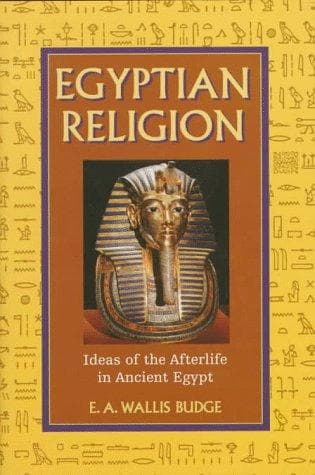
Egyptian Ideas of the Future LifeBudge, E. A. Wallis (Ernest Alfred Wallis), Sir
ReligionComparative
Egyptian Ideas of the Future Life
Budge, E. A. Wallis (Ernest Alfred Wallis), Sir
Egypt -- Religion; Eschatology, Egyptian; Future life
5. NUT was the wife of Seb and the mother of Osiris, Isis, Set, and
Nephthys. Originally she was the personification of the sky, and
represented the feminine principle which was active at the creation of
the universe. According to an old view, Seb and Nut existed in the
primeval watery abyss side by side with Shu and Tefnut; and later Seb
became the earth and Nut the sky. These deities were supposed to unite
every evening, and to remain embraced until the morning, when the god
Shu separated them, and set the goddess of the sky upon his four
pillars until the evening. Nut was, naturally, regarded as the mother
of the gods and of all things living, and she and her husband Seb were
considered to be the givers of food, not only to the living but also
to the dead. Though different views were current in Egypt as to the
exact location of the heaven of the beatified dead, yet all schools of
thought in all periods assigned it to some region in the sky, and the
abundant allusions in the texts to the heavenly bodies--that is, the
sun, moon, and stars--which the deceased dwells with, prove that the
final abode of the souls of the righteous was not upon earth. The
goddess Nut is sometimes represented as a female along whose body the
sun travels, and sometimes as a cow; the tree sacred to her was the
sycamore.
6. Osiris was the son of Seb and Nut, the husband of Isis and the
father of Horus. The history of this god is given elsewhere in this
book so fully that it is only necessary to refer briefly to him. He
was held to be a man although of divine origin; he lived and reigned
as a king on this earth; he was treacherously murdered by his brother
Set, and his body was cut up into fourteen pieces, which were
scattered about Egypt; after his death, Isis, by the use of magical
formulae supplied to her by Thoth, succeeded in raising him to life,
and he begot a son called Horus; when Horus was grown up, he engaged
in combat with Set, and overcame him, and thus "avenged his father";
by means of magical formulae, supplied to him by Thoth, Osiris
reconstituted and revivified his body, and became the type of the
resurrection and the symbol of immortality; he was also the hope, the
judge, and the god of the dead, probably even in pre-dynastic times.
Osiris was in one aspect a solar deity, and originally he seems to
have represented the sun after it had set; but he is also identified
with the moon. In the XVIIIth dynasty, however, he is already the
equal of R[=a], and later the attributes of God and of all the "gods"
were ascribed to him.
Public-domain text, read in full here on John Shaqi.
Reviews
Reviews
No reviews yet
Be the first to share your thoughts on this work.
Elsewhere in the archive
Join the Discussion
Join the discussion
Sign in to leave a comment or review.
Sign InorCreate an account