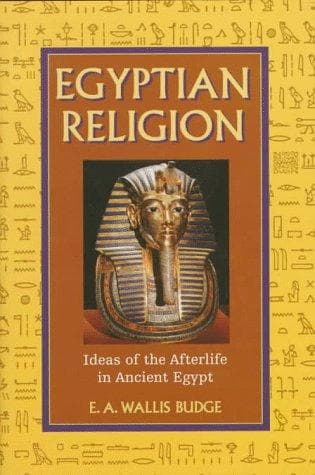
Egyptian Ideas of the Future LifeBudge, E. A. Wallis (Ernest Alfred Wallis), Sir
ReligionComparative
Egyptian Ideas of the Future Life
Budge, E. A. Wallis (Ernest Alfred Wallis), Sir
Egypt -- Religion; Eschatology, Egyptian; Future life
7. Isis was the wife of Osiris and mother of Horus; as a nature
goddess she had a place in the boat of the sun at the creation, when
she probably typified the dawn. By reason of her success in
revivifying her husband's body by means of the utterance of magical
formulae, she is called the "lady of enchantments." Her wanderings in
search of her husband's body, and the sorrow which she endured in
bringing forth and rearing her child in the papyrus swamps of the
Delta, and the persecution which she suffered at the hands of her
husband's enemies, form the subject of many allusions in texts of all
periods. She has various aspects, but the one which appealed most to
the imagination of the Egyptians, was that of "divine mother"; in this
character thousands of statues represent her seated and suckling her
child Horus whom she holds upon her knees.
8. Set was the son of Seb and Nut, and the husband of Nephthys. At a
very early period he was regarded as the brother and friend of "Horus
the Elder," the Aroueris of the Greeks, and Set represented the night
whilst Horus represented the day. Each of these gods performed many
offices of a friendly nature for the dead, and among others they set
up and held the ladder by which the deceased made his way from this
earth to heaven, and helped him to ascend it. But, at a later period,
the views of the Egyptians concerning Set changed, and soon after the
reign of the kings called "Seti," _i.e._, those whose names were based
upon that of the god, he became the personification of all evil, and
of all that is horrible and terrible in nature, such as the desert in
its most desolate form, the storm and the tempest, etc. Set, as a
power of nature, was always waging war with Horus the Elder, _i.e._,
the night did battle with the day for supremacy; both gods, however,
sprang from the same source, for the heads of both are, in one scene,
made to belong to one body. When Horus, the son of Isis, had grown up,
he did battle with Set, who had murdered Horus's father Osiris, and
vanquished him; in many texts these two originally distinct fights are
confused, and the two Horus gods also. The conquest of Set by Horus in
the first conflict typified only the defeat of the night by the day,
but the defeat of Set in the second seems to have been understood as
the victory of life over death, and of good over evil. The symbol of
Set was an animal with a head something like that of a camel, but it
has not yet been satisfactorily identified; figures of the god are
uncommon, for most of them were destroyed by the Egyptians when they
changed their views about him.
Public-domain text, read in full here on John Shaqi.
Reviews
Reviews
No reviews yet
Be the first to share your thoughts on this work.
Elsewhere in the archive
Join the Discussion
Join the discussion
Sign in to leave a comment or review.
Sign InorCreate an account