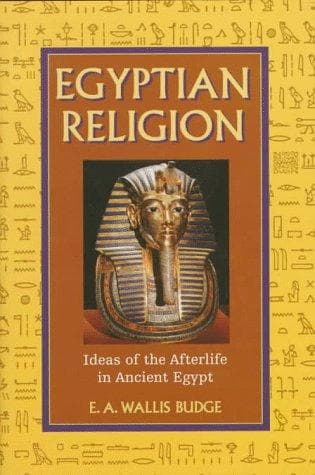
Egyptian Ideas of the Future LifeBudge, E. A. Wallis (Ernest Alfred Wallis), Sir
ReligionComparative
Egyptian Ideas of the Future Life
Budge, E. A. Wallis (Ernest Alfred Wallis), Sir
Egypt -- Religion; Eschatology, Egyptian; Future life
In Chapter 30A there is no mention made of the "guardian of the
balance," and the deceased says, "May naught stand up to oppose me in
judgment in the presence of the lords of things!" The "lords of things"
may be either the "lords of creation," _i.e._, the great cosmic gods, or
the "lords of the affairs [of the hall of judgment]," _i.e._, of the
trial. In this chapter the deceased addresses not Khnemu, but "the gods
who dwell in the divine clouds, and who are exalted by reason of their
sceptres," that is to say, the four gods of the cardinal points, called
Mestha, H[=a]pi Tuamutef, and Qebhsennuf, who also presided over the
chief internal organs of the human body. Here, again, it seems as if the
deceased was anxious to make these gods in some way responsible for the
deeds done by him in his life, inasmuch as they presided, over the
organs that were the prime movers of his actions. In any case, he
considers them in, the light of intercessors, for he beseeches them to
"speak fair words unto R[=a]" on his behalf, and to make him to prosper
before the goddess Nehebka. In this case, the favour of R[=a], the
Sun-god, the visible emblem of the almighty and eternal God, is sought
for, and also that of the serpent goddess, whose attributes are not yet
accurately defined, but who has much to do with the destinies of the
dead. No mention whatever is made of the Lord of Amentet--Osiris.
Before we pass to the consideration of the manner in which the judgment
is depicted upon the finest examples of the illustrated papyri,
reference must be made to an interesting vignette in the papyri of
Nebseni [Footnote: British Museum, No. 9900.] and Amen-neb. [Footnote 2:
British Museum, No. 0964.] In both of these papyri we see a figure of
the deceased himself being weighed in the balance against his own heart
in the presence of the god Osiris. It seems probable that a belief was
current at one time in ancient Egypt concerning the possibility of the
body being weighed against the heart, with the view of finding out if
the former had obeyed the dictates of the latter; be that as it may,
however, it is quite certain that this remarkable variant of the
vignette of Chapter 30B had some special meaning, and, as it occurs in
two papyri which date from the XVIIIth dynasty, we are justified in
assuming that it represents a belief belonging to a much older period.
The judgment here depicted must, in any case, be different from that
which forms such a striking scene in the later illustrated papyri of the
XVIIIth and following dynasties.
Public-domain text, read in full here on John Shaqi.
Reviews
Reviews
No reviews yet
Be the first to share your thoughts on this work.
Elsewhere in the archive
Join the Discussion
Join the discussion
Sign in to leave a comment or review.
Sign InorCreate an account