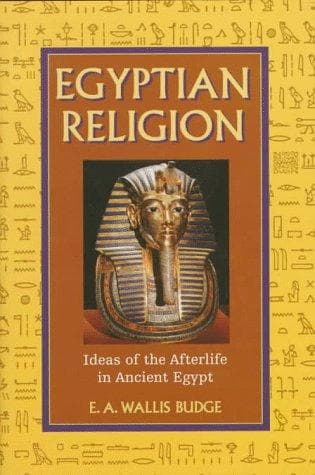
Egyptian Ideas of the Future LifeBudge, E. A. Wallis (Ernest Alfred Wallis), Sir
ReligionComparative
Egyptian Ideas of the Future Life
Budge, E. A. Wallis (Ernest Alfred Wallis), Sir
Egypt -- Religion; Eschatology, Egyptian; Future life
"Grant that I may follow in the train of thy Majesty even as I did
upon earth. Let my soul be called [into the presence], and let it be
found by the side of the lords of right and truth. I have come into
the City of God, the region which existed in primeval time, with [my]
soul, and with [my] double, and with [my] translucent form, to dwell
in this land. The God thereof is the lord of right and truth, he is
the lord of the _tchefau_ food of the gods, and he is most holy. His
land draweth unto itself every land; the South cometh sailing down the
river thereto, and the North, steered thither by winds, cometh daily
to make festival therein according to the command of the God thereof,
who is the Lord of peace therein. And doth he not say, 'The happiness
thereof is a care unto me'? The god who dwelleth therein worketh right
and truth; unto him that doeth these things he giveth old age, and to
him that followeth after them rank and honour, until at length he
attaineth unto a happy funeral and burial in the Holy Land" (_i.e._,
the underworld).
The deceased, having recited these words of prayer and adoration to
R[=a], the symbol of Almighty God, and to his son Osiris, next "cometh
forth into the Hall of Ma[=a]ti, that he may be separated from every sin
which he hath done, and may behold the faces of the gods." [Footnote:
This quotation is from the title of Chapter CXXV. of the Book of the
Dead.] From the earliest times the Ma[=a]ti were the two goddesses Isis
and Nephthys, and they were so called because they represented the ideas
of straightness, integrity, righteousness, what is right, the truth, and
such like; the word Ma[=a]t originally meant a measuring reed or stick.
They were supposed either to sit in the Hall of Ma[=a]t outside the
shrine of Osiris, or to stand by the side of this god in the shrine; an
example of the former position will be seen in the Papyrus of Ani (Plate
31), and of the latter in the Papyrus of Hunefer (Plate 4). The original
idea of the Hall of Ma[=a]t or Ma[=a]ti was that it contained forty-two
gods; a fact which we may see from the following passage in the
Introduction to Chapter CXXV. of the Book of the Dead. The deceased says
to Osiris:--
"Homage to thee, O thou great God, thou Lord of the two Ma[=a]t
goddesses! I have come to thee, O my Lord, and I have made myself to
come hither that I may behold thy beauties. I know thee, and I know
thy name, and I know the names of the two and forty gods who live with
thee in this Hall of Ma[=a]ti, who live as watchers of sinners and who
feed upon their blood on that day when the characters (_or_ lives) of
men are reckoned up (_or_ taken into account) in the presence of the
god Un-nefer. Verily, God of the Rekhti-Merti (_i.e._, the twin
sisters of the two eyes), the Lord of the city of Ma[=a]ti is thy
name. Verily I have come to thee, and I have brought Ma[=a]t unto
thee, and I have destroyed wickedness."
Public-domain text, read in full here on John Shaqi.
Reviews
Reviews
No reviews yet
Be the first to share your thoughts on this work.
Elsewhere in the archive
Join the Discussion
Join the discussion
Sign in to leave a comment or review.
Sign InorCreate an account