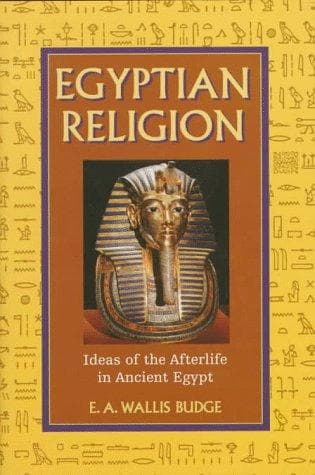
Egyptian Ideas of the Future LifeBudge, E. A. Wallis (Ernest Alfred Wallis), Sir
ReligionComparative
Egyptian Ideas of the Future Life
Budge, E. A. Wallis (Ernest Alfred Wallis), Sir
Egypt -- Religion; Eschatology, Egyptian; Future life
With these words Chapter CXXV comes to an end. We have seen how the
deceased has passed through the ordeal of the judgment, and how the
scribes provided him with hymns and prayers, and with the words of a
confession with a view of facilitating his passage through the dread
Hall of the Ma[=a]ti goddesses. Unfortunately the answer which the god
Osiris may be supposed to have made to his son Horus in respect of the
deceased is not recorded, but there is no doubt that the Egyptian
assumed that it would be favourable to him, and that permission would be
accorded him to enter into each and every portion of the underworld, and
to partake of all the delights which the beatified enjoyed under the
rule of R[=a] and Osiris.
CHAPTER V.
THE RESURRECTION AND IMMORTALITY.
In perusing the literature of the ancient Egyptians one of the first
things which forces itself upon the mind of the reader is the frequency
of allusions to the future life or to things which appertain thereto.
The writers of the various religious and other works, belonging to all
periods of Egyptian history, which have come down to us, tacitly assume
throughout that those who once have lived in this world have "renewed"
their life in that which is beyond the grave, and that they still live
and will live until time shall be no more. The Egyptian belief in the
existence of Almighty God is old, so old that we must seek for its
beginnings in pre-dynastic times; but the belief in a future life is
very much older, and its beginnings must be as old, at least, as the
oldest human remains which have been found in Egypt. To attempt to
measure by years the remoteness of the period when these were committed
to the earth, is futile, for no date that could be given them is likely
to be even approximately correct, and they may as well date from B.C.
12,000 as from B.C. 8000. Of one fact, however, we may be quite certain;
that is to say, that the oldest human remains that have been found in
Egypt bear upon them traces of the use of bitumen, which proves that the
Egyptians at the very beginning of their stay in the valley of the Nile
made some attempt to preserve their dead by means of mummification.
[Footnote: See J. de Morgan, _Ethnographie Préhistorique_, Paris, 1897,
p. 189.] If they were, as many think, invaders who had made their way
across Arabia and the Red Sea and the eastern desert of the Nile, they
may have brought the idea and habit of preserving their dead with them,
or they may have adopted, in a modified form, some practice in use among
the aboriginal inhabitants whom they found on their arrival in Egypt; in
either case the fact that they attempted to preserve their dead by the
use of substances which would arrest decay is certain, and in a degree
their attempt has succeeded.
Public-domain text, read in full here on John Shaqi.
Reviews
Reviews
No reviews yet
Be the first to share your thoughts on this work.
Elsewhere in the archive
Join the Discussion
Join the discussion
Sign in to leave a comment or review.
Sign InorCreate an account