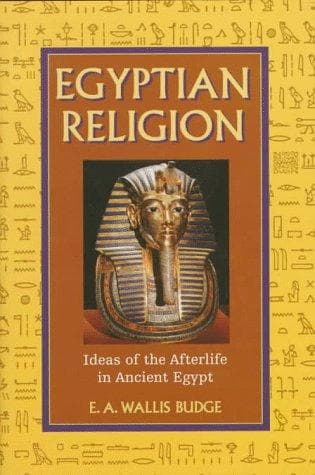
Egyptian Ideas of the Future LifeBudge, E. A. Wallis (Ernest Alfred Wallis), Sir
ReligionComparative
Egyptian Ideas of the Future Life
Budge, E. A. Wallis (Ernest Alfred Wallis), Sir
Egypt -- Religion; Eschatology, Egyptian; Future life
But once having imagined a new life, probably in a new body,
death a second time was not, the prehistoric Egyptian hoped, within the
bounds of possibility. Here, then, we have the origin of the grand ideas
of the RESURRECTION and IMMORTALITY.
There is every reason for believing that the prehistoric Egyptian
expected to eat, and to drink, and to lead a life of pleasure in the
region where he imagined his heaven to be, and there is little doubt
that he thought the body in which he would live there would be not
unlike the body which he had while he was upon earth. At this stage his
ideas of the supernatural and of the future life would be like those of
any man of the same race who stood on the same level in the scale of
civilization, but in every way he was a great contrast to the Egyptian
who lived, let us say, in the time of Mena, the first historical king of
Egypt, the date of whom for convenience' sake is placed at B.C. 4400.
The interval between the time when the prehistoric Egyptians made the
graves described above and the reign of Mena must have been very
considerable, and we may justly believe it to represent some thousands
of years; but whatever its length, we find that the time was not
sufficient to wipe out the early views which had been handed on from
generation to generation, or even to modify some of the beliefs which we
now know to have existed in an almost unchanged state at the latest
period of Egyptian history. In the texts which were edited by the
priests of Heliopolis we find references to a state or condition of
things, as far as social matters are concerned, which could only exist
in a society of men who were half savages. And we see from later works,
when extracts are made from the earlier texts which contain such
references, that the passages in which objectionable allusions occur are
either omitted altogether or modified. We know of a certainty that the
educated men of the College of Heliopolis cannot have indulged in the
excesses which the deceased kings for whom they prepared the funeral
texts are assumed to enjoy, and the mention of the nameless abomination
which the savage Egyptian inflicted upon his vanquished foe can only
have been allowed to remain in them because of their own reverence for
the written word.
Public-domain text, read in full here on John Shaqi.
Reviews
Reviews
No reviews yet
Be the first to share your thoughts on this work.
Elsewhere in the archive
Join the Discussion
Join the discussion
Sign in to leave a comment or review.
Sign InorCreate an account