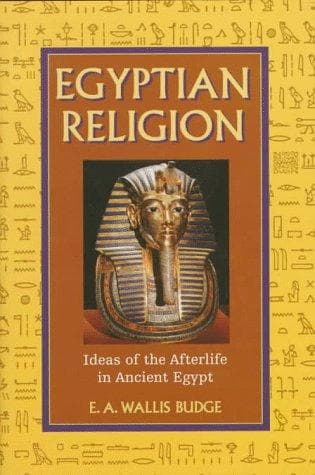
Egyptian Ideas of the Future LifeBudge, E. A. Wallis (Ernest Alfred Wallis), Sir
ReligionComparative
Egyptian Ideas of the Future Life
Budge, E. A. Wallis (Ernest Alfred Wallis), Sir
Egypt -- Religion; Eschatology, Egyptian; Future life
It will be remembered that when Isis found the dead body of her husband
Osiris, she at once set to work to protect it. She drove away the foes,
and made the ill-luck which had come upon it to be of no effect. In
order to bring about this result "she made strong her speech with all
the strength of her mouth, she was perfect of tongue, and she halted not
in her speech," and she pronounced a series of words or formulae with
which Thoth had provided her; thus she succeeded in "stirring up the
inactivity of the Still-heart" and in accomplishing her desire in
respect of him. Her cries, prompted by love and grief, would have had no
effect on the dead body unless they had been accompanied by the words of
Thoth, which she uttered with boldness (_Ichu_), and understanding
(_ager_), and without fault in pronunciation (_an-uh_). The Egyptian of
old kept this fact in his mind, and determined to procure the
resurrection of his friends and relatives by the same means as Isis
employed, _i.e._, the formulae of Thoth; with this object in view each
dead person, was provided with a series of texts, either written upon
his coffin, or upon papyri and amulets, which would have the same effect
as the words of Thoth which were spoken by Isis. But the relatives of
the deceased had also a duty to perform in this matter, and that was to
provide for the recital of certain prayers, and for the performance of a
number of symbolical ceremonies over the dead body before It was laid to
rest finally in the tomb. A sacrifice had to be offered up, and the
deceased and his friends and relatives assisted at it, and each ceremony
was accompanied by its proper prayers; when all had been done and said
according to the ordinances of the priests, the body was taken, to its
place in the mummy chamber. But the words of Thoth and the prayers of
the priests caused the body to become changed into a "S[=A]HU," or
incorruptible, spiritual body, which passed straightway out of the tomb
and made its way to heaven where it dwelt with the gods. When, in the
Book of the Dead the deceased says, "I exist, I exist; I live, I live; I
germinate, I germinate," [Footnote: See Chap. cliv.] and again, "I
germinate like the plants," [Footnote: See Chap. lxxxviii. 3.] the
deceased does not mean that his physical body is putting forth the
beginnings of another body like the old one, but a spiritual body which
"hath neither defect nor, like R[=a], shall suffer diminution for ever."
Into the S[=A]HU passed the soul which had lived in the body of a man
upon earth, and it seems as if the new, incorruptible body formed the
dwelling-place of the soul in heaven just as the physical body had been
its earthly abode. The reasons why the Egyptians continued to mummify
their dead is thus apparent; they did not do so believing that their
physical bodies would rise again, but because they wished the spiritual
body to "sprout" or "germinate" from them, and if possible--at least it
Public-domain text, read in full here on John Shaqi.
Reviews
Reviews
No reviews yet
Be the first to share your thoughts on this work.
Elsewhere in the archive
Join the Discussion
Join the discussion
Sign in to leave a comment or review.
Sign InorCreate an account