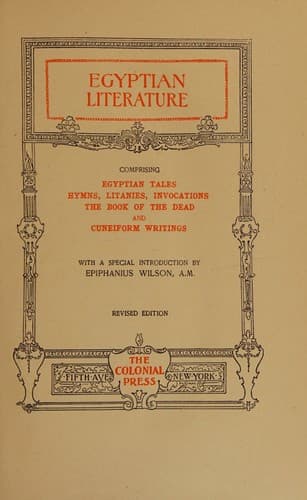
Egyptian Literature: Comprising Egyptian tales, hymns, litanies, invocations, the Book of the Dead, and cuneiform writings
Religion
Egyptian Literature: Comprising Egyptian tales, hymns, litanies, invocations, the Book of the Dead, and cuneiform writings
Egyptian literature -- Translations into English
up my heart and gathered strength, I heard a voice and the lowing of
cattle. I saw men of the Sati, and one of them—a friend unto Egypt—knew
me. Behold he gave me water and boiled me milk, and I went with him to his
camp; they did me good, and one tribe passed me on to another. I passed on
to Sun, and reached the land of Adim (Edom).
When I had dwelt there half a year Amu-an-shi—who is the Prince of the
Upper Tenu—sent for me and said: “Dwell thou with me that thou mayest hear
the speech of Egypt.” He said thus for that he knew of my excellence, and
had heard tell of my worth, for men of Egypt who were there with him bore
witness of me. Behold he said to me: “For what cause hast thou come
hither? Has a matter come to pass in the palace? Has the King of the two
lands, Sehetepabra, gone to heaven? That which has happened about this is
not known.” But I answered with concealment, and said: “When I came from
the land of the Tamahu, and my desires were there changed in me, if I fled
away it was not by reason of remorse that I took the way of a fugitive; I
have not failed in my duty, my mouth has not said any bitter words, I have
not heard any evil counsel, my name has not come into the mouth of a
magistrate. I know not by what I have been led into this land.” And
Amu-an-shi said: “This is by the will of the god (King of Egypt); for what
is a land like if it know not that excellent god, of whom the dread is
upon the lands of strangers, as they dread Sekhet in a year of
pestilence?” I spake to him, and replied: “Forgive me; his son now enters
the palace, and has received the heritage of his father. He is a god who
has none like him, and there is none before him. He is a master of wisdom,
prudent in his designs, excellent in his decrees, with good-will to him
who goes or who comes; he subdued the land of strangers while his father
yet lived in his palace, and he rendered account of that which his father
destined him to perform. He is a brave man, who verily strikes with his
sword; a valiant one, who has not his equal; he springs upon the
barbarians, and throws himself on the spoilers; he breaks the horns and
weakens the hands, and those whom he smites cannot raise the buckler. He
is fearless, and dashes the heads, and none can stand before him. He is
swift of foot, to destroy him who flies; and none who flees from him
reaches his home. His heart is strong in his time; he is a lion who
strikes with the claw, and never has he turned his back. His heart is
closed to pity; and when he sees multitudes, he leaves none to live behind
him. He is a valiant one who springs in front when he sees resistance; he
is a warrior who rejoices when he flies on the barbarians. He seizes the
buckler, he rushes forward, he never needs to strike again, he slays and
none can turn his lance; and when he takes the bow the barbarians flee
from his arms like dogs; for the great goddess has given to him to strike
Public-domain text, read in full here on John Shaqi.
Reviews
Reviews
No reviews yet
Be the first to share your thoughts on this work.
Elsewhere in the archive
Join the Discussion
Join the discussion
Sign in to leave a comment or review.
Sign InorCreate an account