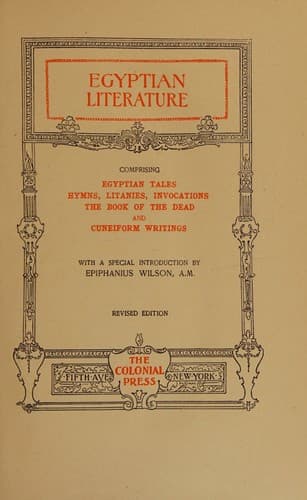
Egyptian Literature: Comprising Egyptian tales, hymns, litanies, invocations, the Book of the Dead, and cuneiform writings
Religion
Egyptian Literature: Comprising Egyptian tales, hymns, litanies, invocations, the Book of the Dead, and cuneiform writings
Egyptian literature -- Translations into English
“O wise King, the wise words which are pronounced in the wisdom of the
majesty of the sovereign, thy humble servant fears to tell. It is a great
thing to repeat. O great God, like unto Rā in fulfilling that to which he
has set his hand, what am I that he should take thought for me? Am I among
those whom he regards, and for whom he arranges? Thy majesty is as Horus,
and the strength of thy arms extends to all lands.
“Then let his Majesty bring Maki of Adma, Kenti-au-ush of Khenti-keshu,
and Tenus from the two lands of the Fen-khu; these are the princes who
bear witness of me as to all that has passed, out of love for thyself.
Does not Tenu believe that it belongs to thee like thy dogs? Behold this
flight that I have made: I did not have it in my heart; it was like the
leading of a dream, as a man of Adehi (Delta) sees himself in Abu
(Elephantine), as a man of the plain of Egypt who sees himself in the
deserts. There was no fear, there was no hastening after me, I did not
listen to an evil plot, my name was not heard in the mouth of the
magistrate; but my limbs went, my feet wandered, my heart drew me; my god
commanded this flight, and drew me on; but I am not stiff-necked. Does a
man fear when he sees his own land? Rā spread thy fear over the land, thy
terrors in every strange land. Behold me now in the palace, behold me in
this place; and lo! thou art he who is over all the horizon; the sun rises
at thy pleasure, the water in the rivers is drunk at thy will, the wind in
heaven is breathed at thy saying.
“I who speak to thee shall leave my goods to the generations to follow in
this land. And as to this messenger who is come even let thy majesty do as
pleaseth him, for one lives by the breath that thou givest. O thou who art
beloved of Rā, of Horus, and of Hathor; Mentu, lord of Thebes, desires
that thy august nostril should live forever.”
I made a feast in Iaa, to pass over my goods to my children. My eldest son
was leading my tribe, all my goods passed to him, and I gave him my corn
and all my cattle, my fruit, and all my pleasant trees. When I had taken
my road to the south, and arrived at the roads of Horus, the officer who
was over the garrison sent a messenger to the palace to give notice. His
Majesty sent the good overseer of the peasants of the King’s domains, and
boats laden with presents from the King for the Sati who had come to
conduct me to the roads of Horus. I spoke to each one by his name, and I
gave the presents to each as was intended. I received and I returned the
salutation, and I continued thus until I reached the city of Thetu.
When the land was brightened, and the new day began, four men came with a
summons for me; and the four men went to lead me to the palace. I saluted
with both my hands on the ground; the royal children stood at the
courtyard to conduct me: the courtiers who were to lead me to the hall
brought me on the way to the royal chamber.
Public-domain text, read in full here on John Shaqi.
Reviews
Reviews
No reviews yet
Be the first to share your thoughts on this work.
Elsewhere in the archive
Join the Discussion
Join the discussion
Sign in to leave a comment or review.
Sign InorCreate an account