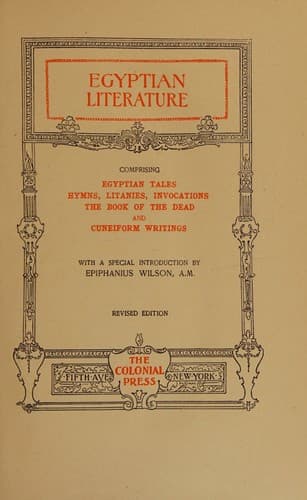
Egyptian Literature: Comprising Egyptian tales, hymns, litanies, invocations, the Book of the Dead, and cuneiform writings
Religion
Egyptian Literature: Comprising Egyptian tales, hymns, litanies, invocations, the Book of the Dead, and cuneiform writings
Egyptian literature -- Translations into English
96 B., a letter mainly complimentary, from _Neboyapiza_(142) to the King
of Egypt, ends as follows:
“Behold I myself, with my soldiers and my chariots, with my brethren and
with (men of blood?) and with my people the men of my kindred go to meet
the Egyptian soldiers, as far as the ground which the King my Lord will
name.”
142 B.—“To the King my Lord thus saith this thy servant. At the feet of my
Lord my Sun seven times on my face, seven times I bow. My Lord I am thy
servant, and they will devour me—_Neboyapiza_: we abide before thy face,
my Lord, and lo! they will devour me in your sight. Behold every fortress
of my fathers is taken, by the people out of the city _Gidisi_.(143) And
my fortresses (say) ‘Speed us avengers.’ I make ready, and (because that?)
the _Pakas_(144) of the King my Lord, and the chiefs of his land have
known my faithfulness, behold I complain to the ruler being one approved;
let the ruler consider that (_Neboyapiza_) has given proof ... for now
they have cast thee out. As for me, I have (gathered?) all my brethren,
and we have made the place strong for the King my Lord. I have caused them
to march with my soldiers and with my chariots, and with all my people.
And behold _Neboyapiza_ has sped to all the fortresses of the King my
Lord. Part of the men of blood are from the land _Ammusi_,(145) and (part)
from the land of _Hubi_, and it is won (or reached). But march fast, thou
who art a God(146) and a Sun in my sight, and restore the strongholds
holds to the King my Lord from the men of blood. For they have cast him
out; and the men of blood have rebelled, and are invaders of the King my
Lord. We were obedient to thy yoke, and they have cast out the King my
Lord, and all my brethren.”
It appears, from other letters, that the city of this chief was the
important town _Cumidi_, now _Kamid_, in the southern Lebanon, at the
south end of the Baalbek plain, west of Baal Gad. In Abu el Feda’s time
this town was the capital of the surrounding district.
189 B. is much broken. It is from _Arzana_, chief of the city
_Khazi_.(147) He speaks of an attack on _Tusulti_, by bloody soldiers
fighting against the place, and perhaps of the city _Bel Gidda_ (Baal
Gad),(148) and mentions a _Paka_, or Egyptian official, called _Aman
Khatbi_, named after the Egyptian god Amen. The foes are spoiling the
valley (of Baalbek) in sight of the Egyptian general, and are attacking
_Khazi_, his city. They had already taken _Maguzi_,(149) and are spoiling
Baal Gad. It seems that he asks the King not to blame his general, and
speaks finally of friendly and faithful men.
43 B. M., broken at the top, reads thus:
Public-domain text, read in full here on John Shaqi.
Reviews
Reviews
No reviews yet
Be the first to share your thoughts on this work.
Elsewhere in the archive
Join the Discussion
Join the discussion
Sign in to leave a comment or review.
Sign InorCreate an account