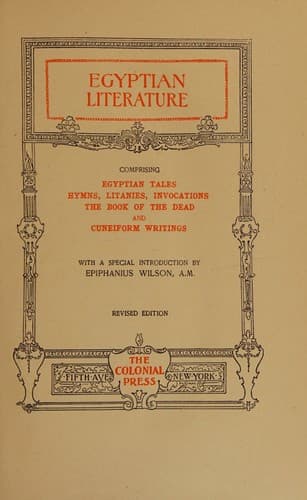
Egyptian Literature: Comprising Egyptian tales, hymns, litanies, invocations, the Book of the Dead, and cuneiform writings
Religion
Egyptian Literature: Comprising Egyptian tales, hymns, litanies, invocations, the Book of the Dead, and cuneiform writings
Egyptian literature -- Translations into English
13 B. M.—The usual salutation, as given in the first letter. “Does the
King know? Behold _Aziru_ has fought my chiefs, and has taken twelve of my
chiefs, and has insisted on receiving at our expense fifty talents; and
the chiefs whom I despatched to the city _Simyra_ he has caused to be
seized in the city. Both the city _Beruta_ (Beirût) and the city _Ziduna_
(Sidon) are sending ships to the city _Simyra_. All who are in the land of
the _Amorites_ have gathered themselves. I am to be attacked; and behold
this: _Yapaaddu_ has fought for me with _Aziru_, but afterward behold he
was entangled in the midst of the enemy when my ships were taken. And the
King sees as to his city and his servant, and I need men to save the
rebellion of this land if you will not come up to save from the hands of
my enemies (or destroyers). Send me back a message, and know the deed that
they have done. Now as they send to thee concerning the city _Simyra_ he
now marches. But (give?) me soldiers for ... and these shall deliver her
... they have tried but ... now.”
61 B.—The usual salutation precedes, here much broken. “Does the King my
Lord know? Lo! we know that he has fought mightily. Lo! they tell of us in
thy presence what the city _Simyra_ has done to the King. Know O King
boldly marching they have contrived to seize her—the sons of _Abdasherah_,
and (there is) none who lives to carry the message to the King. But
counsel now thy faithful servant. I say also the whole of the fortress
they have destroyed ... I sent to the King ... of advice as to the city
_Simyra_. As a bird in the midst of the net she has remained. The siege of
the usurpers is exceeding strong, and the messenger who from...”
The letter is much broken. It refers to Yapaaddu and to his own
faithfulness to the _Pakas_ (“chiefs”) of the King. He also appears to
refer to the King destroying the Amorites, and goes on:
Public-domain text, read in full here on John Shaqi.
Reviews
Reviews
No reviews yet
Be the first to share your thoughts on this work.
Elsewhere in the archive
Join the Discussion
Join the discussion
Sign in to leave a comment or review.
Sign InorCreate an account