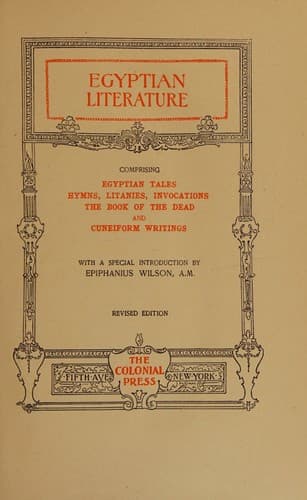
Egyptian Literature: Comprising Egyptian tales, hymns, litanies, invocations, the Book of the Dead, and cuneiform writings
Religion
Egyptian Literature: Comprising Egyptian tales, hymns, litanies, invocations, the Book of the Dead, and cuneiform writings
Egyptian literature -- Translations into English
28 B. M.—“To the King my Lord my Sun my God thus (says) _Abimelec_ thy
servant; seven and seven (times) at the feet of the King my Lord I bow. I
am the dust beneath the feet. Consider me O King my Lord. The King my Lord
(is) like the Sun; like the air god (or Adonis) in heaven art thou. Let
the King advise his servant: the King my Lord confides in me. I watch the
city of _Tyre_ the handmaid of the King. And I send a hasty letter to the
King my Lord, and no order does he return to me. I am the _Paka_(296)
(chief) of the King my Lord, and I have diligently followed what was
ordered. But as to our silence to the King my Lord let the King be
assured. As a subject I guard his city. And let me plead (or strive)
before the King my Lord, and let him see his face. Who shall preserve one
born a subject? Lo there has gone forth no command from the hands of the
King his Lord; and he may not know when the King sends to his servant. He
may never know. As for me ...”
The letter is here too broken to read consecutively. It refers to the
“west,” and apparently to “burning,” to _Aziru_, and to someone, perhaps a
king’s messenger, called _Khabi_. The letter becomes readable on the back
of the tablet.
“... by _Elisaru_ the messenger it is confirmed that the city of _Simyra_
is _Aziru’s_. And is not the King nourished by his city of _Tyre_, by his
country? Lo! if I shall be destroyed the King is destroyed. But thus his
fortress has been wasted, and there has been great fear, and all the lands
have feared; for he has not walked after (_i.e._, obeyed) the King my
Lord. O King know: desolation has remained with me—with the _Paka_ in the
city of _Tyre_. _Zimridi_ is gone to the city _Irib_.(297) He has escaped
from slavery; and there is no water or wood for us; and alas! there is
none remaining to stand up for me. The chief is helpless. And let the King
my Lord advise his servant by a letter he sends to me, whom you thus hear.
And _Zimrida_ of the city of _Sidon_ has sent to the King, and _Aziru_ is
a man sinful against the King, and the chiefs of the city _Arāda_ (Arvad)
destroy me,(298) and (everything is altered?) through their ravages; and
they will gather their ships, their chariots, their foot soldiers, to
seize the city of _Tyre_ the King’s handmaid. She has been very constant
to the King’s hand, and the city of _Tyre_ has been crushed by them. Were
they not violent in taking the city of _Simyra_? They took from the hands
of _Zimrida_ him who bore the King’s order to _Aziru_; and I sent a letter
to the King my Lord, and he returns me not an order for his servant. They
have fought (for a long time?) against me. There are no waters(299) and no
trees. Let there be ordered a letter for his servant, and let me plead,
and let me see his face, and the King ... to his servant, and to his city,
and not ... his city and his land. Why do they ... the King our Lord from
the land, and ... and he has known that I honor the King’s power, who ...
no ...
Public-domain text, read in full here on John Shaqi.
Reviews
Reviews
No reviews yet
Be the first to share your thoughts on this work.
Elsewhere in the archive
Join the Discussion
Join the discussion
Sign in to leave a comment or review.
Sign InorCreate an account