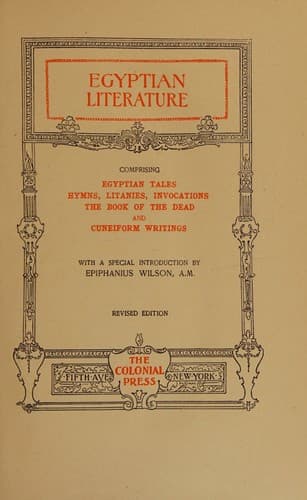
Egyptian Literature: Comprising Egyptian tales, hymns, litanies, invocations, the Book of the Dead, and cuneiform writings
Religion
Egyptian Literature: Comprising Egyptian tales, hymns, litanies, invocations, the Book of the Dead, and cuneiform writings
Egyptian literature -- Translations into English
72 B. M.—“Lo! a letter as to destruction of my brethren because of what
the Gods of the King our Lord have done. And the people of _Labaya_ are
conquered; and so we have ordered _Khaia_(310) that this be borne by him
to the King our Lord. And a (company?) of my horse was placed, and the
people are sent out after him, and he rides with _Yasdata_ also till I
come. And he is gone away to smite him, and now _Yasdata_ is thy servant,
and he strives mightily with me in battle array, and has not he ... the
rule of the King my Lord, and let there be ... to the King my Lord ... and
_Zurata_ is stopping the way of _Labaya_ from the city _Makidda_. And he
asked me to gather ships—my fleet, and it will go straight to inform the
King; and _Zurata_ marches on him and hinders him; from the city of
_’Anana_ which is his. _Zurata_ is damming the marshes. They have
contrived a stoppage of the head (waters) from his drinking. Behold what
thus I have done for the King my Lord. Lo! possession is possible for me,
but it is difficult. My brethren (have become few?) but _Zurata_ delays
_Labaya_, and _Zurata_ hinders _Addumemur_ from them. And does not the
King my Lord know this?”
This letter (confirmed by 154 B.) shows that a town near the sea, not like
Megiddo, inland, is intended. Labaya had apparently taken Makkedah from
Biridia, who had been afraid of it (115 B.). The writer of the present
letter was probably Biridia and he was perhaps blockading the province by
sea on the west, while Yasdata, who was on the east (which agrees with 59
B. M.), blocked up the stream near ’Anana. This site would be the Enam of
the Bible (Josh. xv. 34), which is thus fixed at the ruin of _Kefr ’Ain_,
by the numerous head springs which feed the river _Rubîn_, which passes
close to Makkedah on the south. The marshes here between the hills would
easily be dammed, and the water supply of Makkedah (_el Mughâr_) so cut
off. Makkedah is close to the only stream of perennial water south of
Joppa, and stands high on a cliff, not far from the sea. It is in the
centre of the province, the boundaries of which Labaya’s sons describe
(154 B.).
149 B.—“(To the) King my Lord thus (says) _Addu_(_urbilu_) thy servant at
the feet of my Lord I bow—to the King my Lord. And know thou, behold I
have raised my ... what I desire as to _Milcilu_. Lo! my chiefs are going
against his servants. As to _Takanu_ a chief will march out to subject his
servants for me.(311) And I have requited to this slave what they did to
us.” The letter then becomes broken, but refers to Milcilu, who was the
King of Gezer. Takanu (or Tagi) is mentioned again in connection with
_Givti_ (B. 199).
Public-domain text, read in full here on John Shaqi.
Reviews
Reviews
No reviews yet
Be the first to share your thoughts on this work.
Elsewhere in the archive
Join the Discussion
Join the discussion
Sign in to leave a comment or review.
Sign InorCreate an account