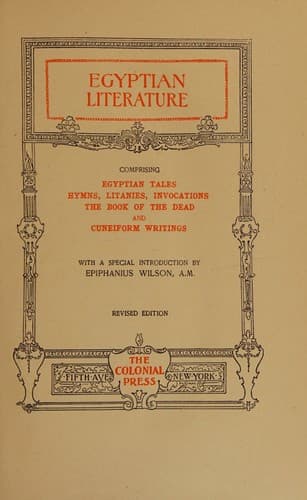
Egyptian Literature: Comprising Egyptian tales, hymns, litanies, invocations, the Book of the Dead, and cuneiform writings
Religion
Egyptian Literature: Comprising Egyptian tales, hymns, litanies, invocations, the Book of the Dead, and cuneiform writings
Egyptian literature -- Translations into English
63 B. M.—“To the King my Lord my God my Sun by letter thus (says)
_Milcili_ thy servant the dust of thy feet. At the feet of the King my
Lord my God my Sun seven times seven times I bow. I hear what the King my
Lord has sent to me, and the King my Lord despatches Egyptian soldiers
(_pitati_) to his servants, and the King my Lord despatches (them) to
dwell as guards. It is apportioned for my honor.”
108 B., with the same salutation, is broken. It appears to refer to
despatching six females, five chiefs, sons of ... and five trusty chiefs
led to the King.(316)
109 B.—Begins with the same salutation as the preceding, and continues:
“The message of the King my Lord my God my Sun to me being brought, now
his command they have done for the King my Lord—the Sun from heaven; and
truly the King my Lord my God my Sun knows, that peaceful is the land of
the King my Lord which is with me.”
110 B.—Begins with the same salutation, and continues: “The King my Lord
shall know. Behold mighty is the war against me, and against
_Suārdatā_;(317) but the King my Lord shall pluck his land from the hands
of men of blood. Since there are none, the King my Lord shall despatch
chariots to march to us ... you will restrain our slaves for us ...
_Yankhamu_ his servant...”
This may refer to the submission of Gezer to the Hebrews mentioned in a
letter from Jerusalem (B. 103).
62 B. M.—Begins with the same salutation as the preceding, and continues:
“Know O King my Lord the demands made to me by _Yankhamu_ since my going
forth from before the King my Lord. Lo! he ... let him take from my hands.
And they say to me (give us?) thy wife and thy sons. And does the King
know this? And does the King my Lord demand despatch of chariots, and that
I shall go to his presence? Nay! Let it be brought to nothing by thee.”
70 B. M., if not from Gezer, must come from near that town. It is written
by _Takanu_, who is mentioned in connection with Milcilu (149 B.) in a
letter from near Makkedah, which was the next great town to Gezer on the
south.
“To the King my Lord thus (says) _Takanu_(318) thy servant: at the feet of
the King my Lord seven times and seven times I bow. Lo! I am the King’s
servant, and the guard of the whole of my roads was in the hands of my
people, but they are now without refuge: they have not come up to guard my
roads for the King my Lord; and ask the chiefs thy _Tarkas_,(319) if they
are not now without refuge for my people. Moreover, behold us. My eyes are
toward thee when I beseech the God of heaven: for we are cast from the
land, and have been needy. We have lacked at thy hand, and behold this
now, the guard that guards my roads is in the hands of a chief who hates
me because of the King my Lord, and the King my Lord shall instruct;
behold send down a host and it shall watch.”
Though the date is doubtful, within limits, this letter probably refers to
the departure of the Egyptian soldiers mentioned in the Jerusalem letters.
Public-domain text, read in full here on John Shaqi.
Reviews
Reviews
No reviews yet
Be the first to share your thoughts on this work.
Elsewhere in the archive
Join the Discussion
Join the discussion
Sign in to leave a comment or review.
Sign InorCreate an account