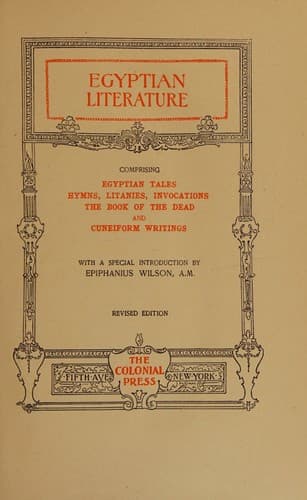
Egyptian Literature: Comprising Egyptian tales, hymns, litanies, invocations, the Book of the Dead, and cuneiform writings
Religion
Egyptian Literature: Comprising Egyptian tales, hymns, litanies, invocations, the Book of the Dead, and cuneiform writings
Egyptian literature -- Translations into English
Let the King’s (foe) perish by the King ... for me my
foe ... revolted from me. Do not desert this ... send me a chief of
garrison—a _Paka_ of the King, despatched to this thy people. (The women?)
are despatched(346) to the King my Lord (with) men who have been upright.
Four messengers(347) ... to go out. The chiefs of the fort (or camp) are
closing the roads of the pass ... the tribe who have caused the
destruction of the city of _Ajalon_.(348) Let this be known to the King my
Lord. Have not I shown the people despatched a road for the King, though
it is not easy?(349) Lo! the King my Lord has established his law in the
land of the city of _Jerusalem_ forever, and is not the desertion of the
lands of the city of _Jerusalem_ manifest? To the scribe of the King my
Lord this lamentation thus (speaks) _Adonizedek_ thy servant—the
afflicted. Translate the messages well to the King my Lord. O, scribe of
the King my Lord (I am) afflicted, greatly am I afflicted. And thou shalt
perform the desire of our people before the chiefs of the land of
Cush(350) (_Casi_). Truly is not there slaughter with us? Thou shalt make
it ... clear to the chiefs of the land of Cush (_Casi_) ... midst of my
land the people to take ... the King to ... seven times and seven times
... my Lord to me...”
199 B. appears to be from _Adonizedek_, and speaks of _Jerusalem_. Only
the lower third of the tablet remains. The clay is different to that of
the preceding, and it may have been written after the city was left.
“And lo now! the city of _Jerusalem_ when these went away from the land
(was) faithful to the King. Lo! the city of _Gaza_ has remained to the
King. Behold the land of _Harti Cirmiel_(351) belonging to _Takanu_ and
the men of the city _Givti_,(352) they have bowed down, going away from
the land quietly. And truly we do so (or but whether do we do so?). Behold
_Labaya!_(353) and the land _Salabimi_(354) are inhabited by the _Hebrew_
chiefs. _Milcilu_ has sent for (tribute?)(355) and the fellows (say) ‘Have
we not indeed dwelt in (or spoiled?) this land?’ They are adjudging all
that they desire to the men of the city of _Keilah_. And truly we are
leaving the city of _Jerusalem_. The chiefs of the garrison have
left—without an order—through the wastings of this fellow whom I fear.
These march to _Addasi_.(356) He has remained in his land (or camp) in the
city of _Gaza_ ... (women?) ... to the land of Egypt...”
This letter was written apparently after the defeat of Ajalon, perhaps
from Makkedah, where the kings hid in the cave. It is clear from this
correspondence that when they fled, after sending away their harems, the
intention was to reach Egypt. Gaza is not mentioned as taken by Joshua,
and it was here that they expected to find safety.
SUYARDATA’S LETTERS FROM (_Keilah_?)(357)
Public-domain text, read in full here on John Shaqi.
Reviews
Reviews
No reviews yet
Be the first to share your thoughts on this work.
Elsewhere in the archive
Join the Discussion
Join the discussion
Sign in to leave a comment or review.
Sign InorCreate an account