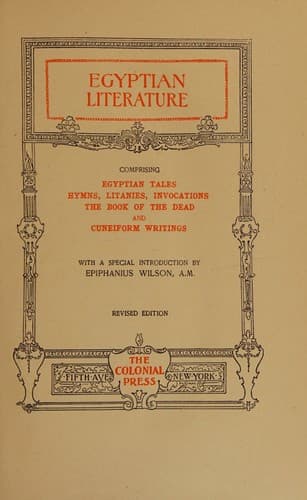
Egyptian Literature: Comprising Egyptian tales, hymns, litanies, invocations, the Book of the Dead, and cuneiform writings
Religion
Egyptian Literature: Comprising Egyptian tales, hymns, litanies, invocations, the Book of the Dead, and cuneiform writings
Egyptian literature -- Translations into English
“The _Canaanites_ in your country, and the Kings ... in your country have
violently cut off ... the silver that they carried—a present ... And the
men who are my servants ... has smitten them. He destroyed our (wealth?);
and as these chiefs he has caused to be slain, it is clear that the man
is, indeed, my foe. And, indeed, they are slaying a chief of your envoys:
when he was an envoy between us he was slain, and his people have been
hostile to you, and the chief my foe, _Sumatta_, dogging his steps, caused
him to be slain; he saw him and slew him. And the other chief _Sutatna_
the _Acchoite_ (though at first they repelled him?) sent his chiefs
against him ... he said thus. Behold this ... ask as to this, truly you
know ... I have sent thee as a present one _manah_ of precious stones ...
my envoy speedily ... truly my brother has known ... do not (blame?) my
envoy ... let him be speedily sent...”
These two last letters of Burnaburias are important as showing the
disturbances in Syria, also mentioned by Dusratta (23 B.) early in the
reign of Amenophis IV.
28 B.—A very broken tablet containing a long list of presents supposed to
have been sent by Burnaburias, and consisting mainly of gold and gems.
LETTERS FROM ALASIYA
7 B. M.—“To the King of _Egypt_ my brother by letter, thus the King of the
Land of _Alasyia_(427) thy brother. I am at peace. Peace be to my brother.
May there be much peace to his house, to his wives, to his son, to his
horses, his chariots, and in his land. My brother’s present (is) fifty
(pounds of bronze?) five yoke of horses. I have sent my brother’s present
(and) my brother’s envoy with speed, and let my brother despatch my
messenger again with speed, and let me ask a gift which ... and.... In his
letter it is directed what to send. He has sent silver. Let him send, not
refusing the explanation of my envoy ... _Cuniea_, _Ebiluna_, _Sirumma_,
_Usbarra_, _Belraam_,(428) the explanation which ... these things which
are with ... my...”
12 B.—The salutation is the same, mentioning only one son of the King of
Egypt.
“My brother has speedily sent my envoys (under escort?), and I heard your
salutation. The chief (and) my merchants my brother has despatched
speedily (under escort?): has not your chief approached with my merchants
and my fleet (or ship)?”
15 B.—A much broken letter from the same, referring to the sending of
copper. The last words appear to be “let him come returning year by year.”
11 B.—The salutation is the same, including “thy house, thy
concubines,(429) thy sons,” etc. This is a very difficult letter, but
appears to read: “Why, my brother, do you utter this message to me? My
brother has known nothing at all that I have not done. As for me, behold
the Chiefs of the land of the Lucci(430) whom you confounded in my land, I
(was) glad should be conquered.”
Public-domain text, read in full here on John Shaqi.
Reviews
Reviews
No reviews yet
Be the first to share your thoughts on this work.
Elsewhere in the archive
Join the Discussion
Join the discussion
Sign in to leave a comment or review.
Sign InorCreate an account