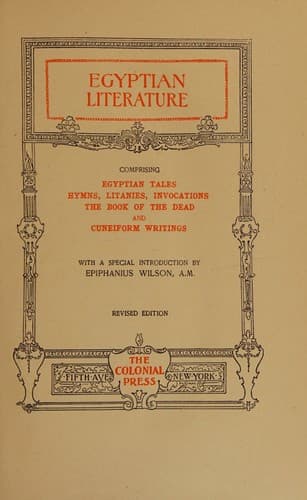
Egyptian Literature: Comprising Egyptian tales, hymns, litanies, invocations, the Book of the Dead, and cuneiform writings
Religion
Egyptian Literature: Comprising Egyptian tales, hymns, litanies, invocations, the Book of the Dead, and cuneiform writings
Egyptian literature -- Translations into English
33 thy porch is magnificent; its doors are like the horizon of the sky, in
order that the multitude may worship thee.
Thy magnificent dwelling has been built inside its walls; thy divine image
is in its
34 mysterious shrine, resting on its high foundation; I have provided it
abundantly with priests, prophets, and cultivators, with land and with
cattle; I have reckoned its offerings by hundreds of thousands of good
things; thy festival of thirty years is celebrated there
35 as thou hast prescribed it to me thyself; all things flock to thee in
the great offering day which thou desirest; the bulls and calves are
innumerable; all the pieces of their flesh are by millions; the smoke of
their fat reaches heaven and is received within the sky.
36 I give that all lands may see the beauty of the buildings which I have
created to thee; I have marked with thy name all inhabitants and
foreigners of the whole land; they are to thee forever; for thou hast
created them, to be under the command of thy son, who is on
37 thy throne, the master of gods and men, the lord who celebrates the
festivals of thirty years like thou, he who wears the double sistrum, the
son of the white crown, and the issue of the red diadem, who unites the
two countries in peace, the King of Egypt, Rā-userma-sotep-en-Rā, the son
of Rā, Rameses, beloved of Amen, living eternally.
Hymn To Osiris
(Stele of Amen-em-ha, Eighteenth Dynasty)
Translated by M. François Chabas
This stele is one of the usual funereal tablets which are found in the
cemeteries at Memphis and Thebes. The upper part of the tablet is round,
and has the two sacred eyes and symbolical signets, which, as well as the
winged globe, almost invariably surmount these sacred inscriptions, and of
which the meaning has not yet been satisfactorily determined.
Immediately below this emblem are two vignettes: in the first a
functionary named Amen-em-ha (“Amen at the beginning”) presents a funereal
offering to his father Amen-mes (“Amen’s son,” or, “born of Amen”) the
steward of the deity’s flocks,(439) beside whom is his deceased wife
Nefer-t-aru and a young boy, his son, Amen-em-ua (“Amen in the bark”). In
the second vignette, a principal priest (_heb_) of Osiris, dressed in the
sacerdotal leopard’s skin, offers incense to the lady Te-bok (“The
servant-maid”); below is a row of kneeling figures, namely: two sons,
Si-t-mau (“Son of the mother”), Amen-Ken (“Amon the warlike”), and four
daughters, Meri-t-ma (“Loving justice”), Amen-Set (“Daughter of Amen”),
Souten-mau (“Royal Mother”), and Hui-em-neter (“Food for god”). As there
is no indication of relationship between the subjects of the two
vignettes, it may be inferred that Te-Bok was a second wife of Amen-em-ha.
Public-domain text, read in full here on John Shaqi.
Reviews
Reviews
No reviews yet
Be the first to share your thoughts on this work.
Elsewhere in the archive
Join the Discussion
Join the discussion
Sign in to leave a comment or review.
Sign InorCreate an account