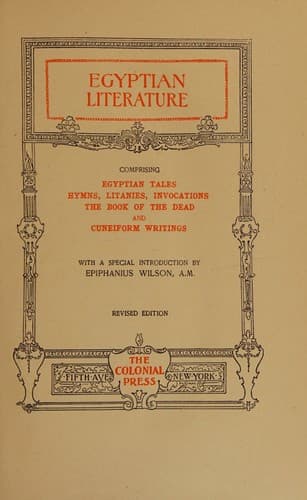
Egyptian Literature: Comprising Egyptian tales, hymns, litanies, invocations, the Book of the Dead, and cuneiform writings
Religion
Egyptian Literature: Comprising Egyptian tales, hymns, litanies, invocations, the Book of the Dead, and cuneiform writings
Egyptian literature -- Translations into English
1 Thou shinest in the city of the King;
2 Then the householders are satiated with good things,
3 The poor man laughs at the lotus.(504)
4 All things are perfectly ordered.
5 Every kind of herb for thy children.
6 If food should fail,
7 All enjoyment is cast on the ground,
8 The land falls in weariness.
XIII.
1 O inundation of Nile, offerings are made to thee:
2 Oxen are slain to thee:
3 Great festivals are kept for thee;
4 Fowls are sacrificed to thee;
5 Beasts of the field are caught for thee
6 Pure flames are offered to thee;
7 Offerings are made to every god,
8 As they are made unto Nile.
9 Incense ascends unto heaven,
10 Oxen, bulls, fowls are burnt!
11 Nile makes for himself chasms in the Thebaid;(505)
12 Unknown is his name in heaven,
13 He doth not manifest his forms!
14 Vain are all representations!(506)
XIV.
1 Mortals extol (him), and the cycle of gods!
2 Awe is felt by the terrible ones;
3 His son(507) is made Lord of all,
4 To enlighten all Egypt.(508)
5 Shine forth, shine forth, O Nile! shine forth!
6 Giving life to men by his oxen:
7 Giving life to his oxen by the pastures!
8 Shine forth in glory, O Nile.
The Solemn Festal Dirge Of The Egyptians
Translated by C. W. Goodwin, M.A.
This dirge or hymn, which is that alluded to by Herodotus,(509) is
contained in one of the “Harris Papyri” (No. 500), the same from which I
have already translated the “Story of the Doomed Prince.” The first line
of the hymn ascribes it to the authorship of King Antuf, one of the
Pharaohs of the eleventh dynasty. The papyrus itself is, however, of the
time of Thothmes III, eighteenth dynasty, but that is no reason why all
the texts in the MSS. should be of the latter date. The translation here
given was printed by myself for the first time in the “Transactions of the
Society of Biblical Archæology,” Vol. III, part 1, but the hieroglyphic
text remains yet to be published. A fragment of another copy of this
identical hymn is to be found in the “_Monumens __ du Musée de Leide_,”
part iii, pl. 12, and from it several words which were wanting in the
Harris papyrus have been restored.
FESTAL DIRGE
1 (Wanting.)
2 The song of the house of King Antuf, deceased, which is
(written) in front of
3 the player on the harp.(510)
All hail to the good Prince,
the worthy good (man),
the body is fated(?) to pass away,
the atoms(511)
4 remain, ever since the time of the ancestors.
The gods who were beforetime rest in their tombs, the
mummies
5 of the saints likewise are enwrapped in their tombs.
They who build houses, and they who have no houses, see!
6 what becomes of them.
I have heard the words of Imhotep(512) and Hartatef.(513)
It is said in their sayings,
Public-domain text, read in full here on John Shaqi.
Reviews
Reviews
No reviews yet
Be the first to share your thoughts on this work.
Elsewhere in the archive
Join the Discussion
Join the discussion
Sign in to leave a comment or review.
Sign InorCreate an account