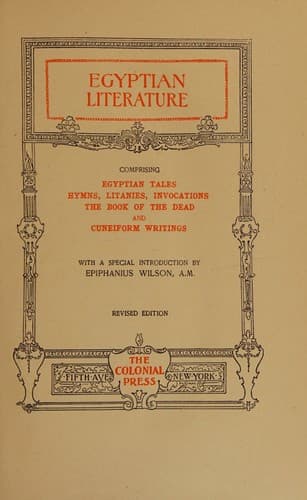
Egyptian Literature: Comprising Egyptian tales, hymns, litanies, invocations, the Book of the Dead, and cuneiform writings
Religion
Egyptian Literature: Comprising Egyptian tales, hymns, litanies, invocations, the Book of the Dead, and cuneiform writings
Egyptian literature -- Translations into English
The text of the following song, found in the tomb of Neferhetep at
Abd-el-Gurnah, is a good specimen of Egyptian poetry of the eighteenth
dynasty. It was first copied by Mr. Dümichen (“_Historische Inschriften_,”
ii. 40), and subsequently by myself. In addition to a translation in the
“_Zeitschrift für ägyptische Sprache_,” 1873, p. 58, I gave some critical
observations in the same journal of 1875. Professor Lauth of Munich
translated it in an appendix to his essay on the music of the ancient
Egyptians.
The song is very remarkable for the form of old Egyptian poetry, which
like that of the Hebrews delights in a sublimer language, in parallelisms
and antitheses, and in the ornament of a burden; no doubt it was sung, and
it seems to be even rhythmic, forming verses of equal length—
“_Ured urui pu mā,_
_Pa shau nefer kheper_
_Khetu her sebt ter rek Rā_
_Jamāu her at r ast-sen._”
Though part of the text is unhappily much mutilated, we yet may gather the
general ideas of the poem from the _disjecta membra_ which remain.
It is a funeral song, supposed to be sung by the harper at a feast or
anniversary in remembrance of the deceased patriarch Neferhetep, who is
represented sitting with his sister and wife Rennu-m-ast-neh, his son
Ptahmes and his daughter Ta-Khat standing by their side, while the harper
before them is chanting. The poet addresses his speech as well to the dead
as to the living, assuming in his fiction the former to be yet alive. The
room of the tomb, on the walls of which such texts were inscribed, may be
thought a kind of chapel appointed for the solemn rites to be performed by
the survivors. The song which bears a great resemblance to the “Song of
the House of King Antef,” lately translated by the eminent Mr. Goodwin,
affords a striking coincidence with the words which Herodotus (ii. 78)
asserts to have been repeated on such occasions, while a wooden image of
the deceased, probably the figure called “_usheb_,” was circulating among
the guests. “Look upon this!” they said; “then drink and rejoice, for thou
shalt be as this is.”
THE SONG OF THE HARPER
[Chanted by the singer to the harp who is in the chapel of the
Osirian, the Patriarch of Amen, the blessed Neferhotep.]
He says:
The great one is truly at rest,
the good charge is fulfilled.
Men pass away since the time of Rā(531)
and the youths come in their stead.
Like as Rā reappears every morning,
and Tum(532) sets in the horizon,
men are begetting,
and women are conceiving.
Every nostril inhaleth once the breezes of dawn,
but all born of women go down to their places.
Public-domain text, read in full here on John Shaqi.
Reviews
Reviews
No reviews yet
Be the first to share your thoughts on this work.
Elsewhere in the archive
Join the Discussion
Join the discussion
Sign in to leave a comment or review.
Sign InorCreate an account