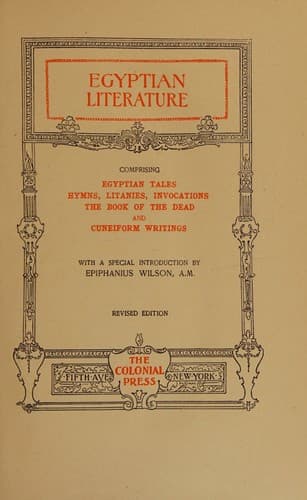
Egyptian Literature: Comprising Egyptian tales, hymns, litanies, invocations, the Book of the Dead, and cuneiform writings
Religion
Egyptian Literature: Comprising Egyptian tales, hymns, litanies, invocations, the Book of the Dead, and cuneiform writings
Egyptian literature -- Translations into English
17 King alone, _single_ among the gods:
of many names, unknown is their number:
rising in the eastern horizon setting in the western horizon:
overthrowing his enemies:
dawning on (his) children daily and every day:
Thoth raises his eyes:
he delights himself with his blessings:
the gods rejoice in his goodness who exalts those _who are lowly_:
Lord of the boat and the barge:
they conduct thee through the firmament in peace.
18 Thy servants rejoice:
beholding the overthrow of the wicked:
his limbs pierced with the _sword_
fire consumes him:
his soul and body are annihilated.
19 Naka(558) saves _his feet_:
the gods rejoice:
the servants of the Sun are in peace:
An is joyful:
the enemies of Athom are overthrown and Aptu is in peace, An is
joyful:
the giver of life is pleased:
at the overthrow of the enemies of her Lord:
the gods of Kher-sa make salutations:
they of the Adytum prostrate themselves.
20 They behold the mighty one in his strength:
the image of the gods of truth the Lord of Aptu;
in thy name of Doer of justice:
Lord of sacrifices, the Bull of offerings:
in thy name of Amen the Bull of his mother:
maker of men:
causing all things which are to exist:
in thy name of Athom Chepra:(559)
the great Hawk making (each) body to rejoice:
benignly making (each) breast to rejoice:
type of creators high crowned:
... (Lord) of the wing:
Uati(560) is on his forehead:
the hearts of men seek him:
when he appears to mortals:
he rejoices the earth with his goings forth:
Hail to thee Amen-Rā Lord of the thrones of the world:
beloved of his city when he shines forth.(561)
Finished well as it was found.(562)
Hymn To Ra-Harmachis
Translated by E. L. Lushington, LL.D., D.C.L.
The hymn to Amen-Rā-Harmachis (the Sun identified with the Supreme Deity),
of which a translation is here attempted, is found, with other
compositions of a similar nature, among the Berlin papyri. (No. 5,
published in Lepsius, “_Denkmäler_,” Abth. vi. Bd. 12, pp. 115-117.)
It probably belongs to the Ramesside period; the writing is careful and
for the most part very distinct; some _lacunæ_ are met with toward the
end, and in a few passages the characters baffle the present translator’s
skill in deciphering.
Citations from this hymn occur not unfrequently in the writings of eminent
Egyptian scholars, as Brugsch, Devéria, and others; compare especially
Chabas, “_Le Nom de Thèbes_,” p. 16, where the long antithesis of epithets
bestowed on Rā and his adversaries is described as “furnishing a page of
the Egyptian dictionary.”
Public-domain text, read in full here on John Shaqi.
Reviews
Reviews
No reviews yet
Be the first to share your thoughts on this work.
Elsewhere in the archive
Join the Discussion
Join the discussion
Sign in to leave a comment or review.
Sign InorCreate an account