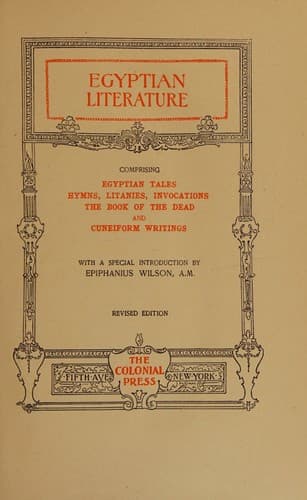
Egyptian Literature: Comprising Egyptian tales, hymns, litanies, invocations, the Book of the Dead, and cuneiform writings
Religion
Egyptian Literature: Comprising Egyptian tales, hymns, litanies, invocations, the Book of the Dead, and cuneiform writings
Egyptian literature -- Translations into English
9 O ye gods, O ye blessed who precede Rā and who escort his
spirit, do to the royal Osiris as to Rā, tow him with you in the
same way that you conduct Rā and the two navigating gods in the
heavens; the royal Osiris is Rā himself, and reciprocally; he is
the Chief of his worshippers who gives life to the forms.
_Section III_
1 O Ament, O Ament, O good, O good, O strong, O strong, O
powerful, O powerful, O protecting, O protecting, O mysterious, O
mysterious (Ament), the royal Osiris knows thee, he knows thy
form, he knows the name of thy companions. Ament, hide my corpse,
good Ament, hide my body. O resting-place, let me rest in thee; O
strong one, may the royal Osiris be strong with thy strength; O
powerful one, may he be powerful with thy power! O Ament, open thy
arms to him; O protectress, cover his body; O mysterious being,
stretch out thy hand to him. Hail, holy Ament of Osiris with the
mysterious names, the most holy of the gods, thou who art the most
hidden of all mysteries. Hail! the royal Osiris worships thee; he
addresses the great god who is within thee. Hail! he worships
thee; open thy mysterious doors to him. Hail! he worships thee;
(open to him) thy hidden spheres, for he has his dwelling in the
heavens like Rā, and his throne is upon the earth like Seb; he is
seated upon the throne of Seb, upon the seats of Horchuti; his
spirit soars into the heavens, it rests there; his body descends
to the earth in the midst of the gods. He walks with Rā, he
follows Tum, he is like Chepra, he lives as thou livest in truth.
2 When this book is read he who reads it purifies himself at the
hour when Rā sets, who rests in the Ament of the Ament, when Rā is
in the midst of hidden things, completely.
The Book Of Respirations
Translated by P. J. De Horrack
The manuscript a translation of which here follows belongs to the Museum
of the Louvre, in Paris, where it is registered under the No. 3284
(_Devéria, Catalogue des MS. égypt._, p. 132). It probably dates from the
epoch of the Ptolemies. It is in hieratic writing and generally known by
the name of “Book of Respirations” or “Book of the Breaths of Life,”
according to Mr. Le Page Renouf’s ingenious interpretation. This book
seems to have been deposited exclusively with the mummies of the priests
and priestesses of the god Ammon-Rā, if we may judge from the titles
inserted into the manuscripts.
Dr. Brugsch, in 1851, first directed the attention of Egyptologists to
this curious work, by publishing a transcription in hieroglyphics of a
hieratic text in the Berlin Museum, with a Latin translation, under the
title of “_Shaï an Sinsin, sive liber Metempsychosis_,” etc. He added to
this a copy of a hieratic text of the same book found in Denon (“_Voyage
en Egypte_,” pl. 136).
Public-domain text, read in full here on John Shaqi.
Reviews
Reviews
No reviews yet
Be the first to share your thoughts on this work.
Elsewhere in the archive
Join the Discussion
Join the discussion
Sign in to leave a comment or review.
Sign InorCreate an account