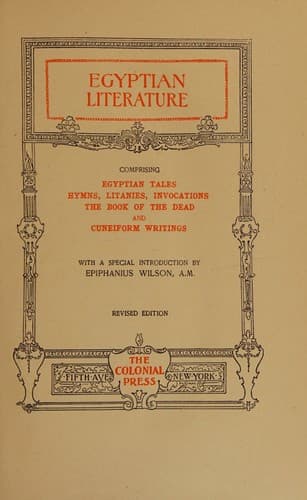
Egyptian Literature: Comprising Egyptian tales, hymns, litanies, invocations, the Book of the Dead, and cuneiform writings
Religion
Egyptian Literature: Comprising Egyptian tales, hymns, litanies, invocations, the Book of the Dead, and cuneiform writings
Egyptian literature -- Translations into English
“Hail, thou Great God who art in thy boat, bring thou me into thy boat. [I
have come forward to thy steps], let me be the director of thy journeyings
and let me be among those who belong to thee and who are among the stars
which never rest. The things which are an abomination unto thee and the
things which are an abomination unto me I will not eat, that which is an
abomination unto me, that which is an abomination unto me is filth and I
will not eat thereof; but sepulchral offerings and holy food [will I eat],
and I shall not be overthrown thereby. I will not draw nigh unto filth
with my hands, and I will not walk thereon with my sandals, because my
bread [is made] of white barley, and my ale [is made] of red barley; and
behold, the _Sektet_ boat and the _Atet_ boat have brought these things
and have laid the gifts(?) of the lands upon the altar of the Souls of
Annu. Hymns of praise be to thee, O Ur-arit-s, as thou travellest through
heaven! Let there be food [for thee], O dweller in the city of Teni
(This), and when the dogs gather together let me not suffer harm. I myself
have come, and I have delivered the god from the things which have been
inflicted upon him, and from the grievous sickness of the body of the arm,
and of the leg. I have come and I have spit upon the body, I have bound up
the arm, and I have made the leg to walk. [I have] entered [the boat] and
[I] sail round about by the command of Rā.”
Of Knowing The Souls Of The East
[From the Papyrus of Nu (British Museum No. 10,477, sheet 12).]
THE CHAPTER OF KNOWING THE SOULS OF THE EAST. The chancellor-in-chief, Nu,
triumphant, saith:
“I, even I, know the eastern gate of heaven—know its southern part is at
the Lake of Kharu and its northern part is at the canal of the
geese—whereout Rā cometh with winds which make him to advance. I am he who
is concerned with the tackle(?) [which is] in the divine bark, I am the
sailor who ceaseth not in the boat of Rā. I, even I, know the two
sycamores of turquoise between which Rā showeth himself when he strideth
forward over the supports of Shu(62) toward the gate of the lord of the
East through which Rā cometh forth. I, even I, know the Sektet-Aarru of
Rā, the walls of which are of iron. The height of the wheat therein is
five cubits, of the ears thereof two cubits, and of the stalks thereof
three cubits. The barley therein is [in height] seven cubits, the ears
thereof are three cubits, and the stalks thereof are four cubits. And
behold, the _Khu_s, each one of whom therein is nine cubits in height,
reap it near the divine Souls of the East. I, even I, know the divine
Souls of the East, that is to say, Heru-khuti (Harmachis), and the Calf of
the goddess Khera, and the Morning Star(63) [daily. A divine city hath
been built for me, I know it, and I know the name thereof; ‘Sekhet-Aarru’
is its name].”(64)
Of Sekhet-Hetepet
[From the Papyrus of Nebseni (British Museum No. 9,900, sheet 17).]
Public-domain text, read in full here on John Shaqi.
Reviews
Reviews
No reviews yet
Be the first to share your thoughts on this work.
Elsewhere in the archive
Join the Discussion
Join the discussion
Sign in to leave a comment or review.
Sign InorCreate an account