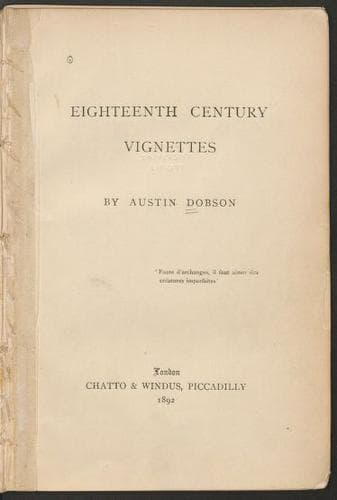
English literature -- 18th century -- History and criticism; Great Britain -- Intellectual life -- 18th century
Then there were those wonderful disorderly dinners, where the guests
were so good and the feast so indifferent; where there were always wit
and learning, and seldom enough of knives and forks; where it was an
honour to have talked and listened, and no one remembered to have dined.
Last comes that pathetic picture of Sir Joshua, when his sight had
failed him, wandering sadly in the inclosure with his green shade over
his eyes, and peering wistfully and vainly for the lost canary which had
been wont to perch upon his finger.
When Reynolds died, Burke wrote his eulogy in the very house where
his body lay. The manuscript (which still exists) was blotted with its
writer's tears. Those royal periods in which the great orator spoke of
his lost friend are too familiar to quote. But after Sir Joshua, the
interest seems to fade out of the Fields, and one willingly draws one's
pen through the few remaining names that are written in its chronicles.
NOTES:
Note 1, p. 91.--A house called Fordhook. This description is, alas! no
longer accurate; and the spot from which Fielding set out for Lisbon in
June, 1754, is now covered by 'commodious villas.'
Note 2, p. 139.--A writer of comedy with the pencil. This happy
characterization was first used by Arthur Murphy in the Gray's Inn
Journal for 9th February, 1754.
Note 3, p. 141.--The original No. 17 of the 'North Briton.' Since the
above was written, my faith in this relic has been rudely shaken. In
looking over a collection of Hogarthiana, temporarily at the British
Museum, I came upon another copy of the paper also purporting to be the
'identical' No. 17, etc. Which is the real Simon Pure? Mr. Standly's
copy (his Catalogue says at p. 84) was given by Mrs. Hogarth to [Samuel]
Ireland. But this second copy I saw, also emanated from that not wholly
unimpeachable source. Collectors will please sympathise.
Note 4, p. 211.--Bronze statue of King James the Second. This statue,
first placed in Whitehall Gardens on the 31st December, 1686 (Bramston's
Autobiography, 1845, p. 253), was transferred in 1897 to an inclosure at
the side of Gwydyr House. The present writer well remembers its forlorn
departure, prone on a trolly, with one leg stiffly extended. It has
again been moved; and now stands at the back of the Admiralty, where
it will doubtless give rise to fresh traditions as to the site of the
execution of Charles I.
Note d, p. 219.--Ink-bottles... dangling from their button-holes.
Flaxman, when he lived in Poland Street, used, in his capacity of parish
officer, to collect the watch rates. On these occasions he always
wore an ink-bottle at his buttonhole. Johnson also bustled about thus
accoutred at the sale of Thrale's brewery (Birkbeck Hill's Boswell,
1887, iv. 87).
Note G, p. 324.--Hogarth's... gold ticket. This is now in the possession
of Mr. Fairfax Murray, who bought it at the Forman sale. But recent
authorities doubt if the design was Hogarth's own.
Public-domain text, read in full here on John Shaqi.
Reviews
Reviews
No reviews yet
Be the first to share your thoughts on this work.
Elsewhere in the archive
Join the Discussion
Join the discussion
Sign in to leave a comment or review.
Sign InorCreate an account