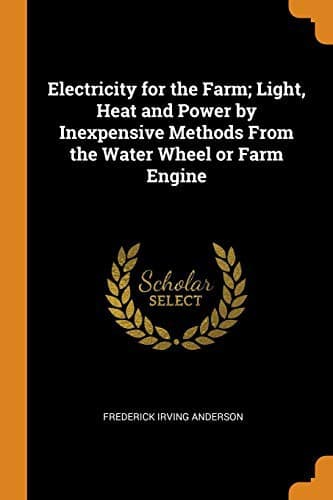
Electricity for the farm: Light, heat and power by inexpensive methods from the water wheel or farm engineAnderson, Frederick Irving
Science
Electricity for the farm: Light, heat and power by inexpensive methods from the water wheel or farm engine
Anderson, Frederick Irving
Electricity in agriculture
The great advantage of water-power is that the expense of
maintenance--once the plant is installed--is practically nothing. This
advantage is offset in some measure by the fact that other forms of
power, gas, steam, or windmills, are already installed, in many
instances and that their judicious use in generating electricity does
not impair their usefulness for the other farm operations for which
they were originally purchased. In recent years gasoline engines have
come into general use on farms as a cheap dependable source of power
for all operations; and windmills date from the earliest times. They
may be installed and maintained cheaply, solely for generating
electricity, if desired. Steam engines, however, require so much care
and expert attention that their use for farm electric plants is not to
be advised, except under conditions where a small portion of their
power can be used to make electricity as a by-product.
There are two types of gasoline engine electric plants suitable for
the farm, in general use:
First: The Standard Voltage Set, in which the engine and dynamo are
mounted on one base, and the engine is kept running when current is
required for any purpose. These sets are usually of the 110-volt type,
and all standard appliances, such as irons, toasters, motors, etc.,
may be used in connection with them. Since the electricity is drawn
directly from the dynamo itself, without a storage battery, it is
necessary that these engines be efficient and governed as to speed
within a five per cent variation from no load to full load.
Second: Storage Battery Sets, in which the dynamo is run only a few
hours each week, and the electricity thus generated is "stored" by
chemical means, in storage batteries, for use when required. Since, in
this case, the current is drawn from the battery, instead of the
dynamo, when used for lighting or other purposes, it is not necessary
that a special type of engine be used to insure constant speed.
_The Standard Voltage Set_
In response to a general demand, the first type (the direct-connected
standard voltage set) has been developed to a high state of efficiency
recently, and is to be had in a great variety of sizes (ranging from
one-quarter kilowatt to 25 kilowatts and over) from many
manufacturers.
The principle of the gasoline engine as motive power is so familiar to
the average farmer that it needs but a brief description here.
Gasoline or other fuel (oil, gas, or alcohol) is transformed into
vapor, mixed with air in correct proportions, and drawn into the
engine cylinder and there exploded by means of a properly-timed
electric spark.
Public-domain text, read in full here on John Shaqi.
Reviews
Reviews
No reviews yet
Be the first to share your thoughts on this work.
Elsewhere in the archive
Join the Discussion
Join the discussion
Sign in to leave a comment or review.
Sign InorCreate an account