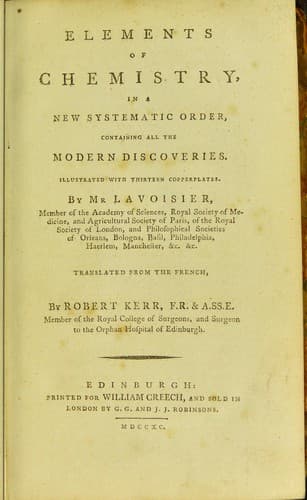
Elements of Chemistry,: In a New Systematic Order, Containing all the Modern DiscoveriesLavoisier, Antoine Laurent
Science
Elements of Chemistry,: In a New Systematic Order, Containing all the Modern Discoveries
Lavoisier, Antoine Laurent
Chemistry -- Early works to 1800
The known salifiable bases, or substances capable of being converted
into neutral salts by union with acids, amount to 24; viz. 3 alkalies, 4
earths, and 17 metallic substances; so that, in the present state of
chemical knowledge, the whole possible number of neutral salts amounts
to 1152[33]. This number is upon the supposition that the metallic acids
are capable of dissolving other metals, which is a new branch of
chemistry not hitherto investigated, upon which depends all the metallic
combinations named _vitreous_. There is reason to believe that many of
these supposable saline combinations are not capable of being formed,
which must greatly reduce the real number of neutral salts producible by
nature and art. Even if we suppose the real number to amount only to
five or six hundred species of possible neutral salts, it is evident
that, were we to distinguish them, after the manner of the ancients,
either by the names of their first discoverers, or by terms derived from
the substances from which they are procured, we should at last have such
a confusion of arbitrary designations, as no memory could possibly
retain. This method might be tolerable in the early ages of chemistry,
or even till within these twenty years, when only about thirty species
of salts were known; but, in the present times, when the number is
augmenting daily, when every new acid gives us 24 or 48 new salts,
according as it is capable of one or two degrees of oxygenation, a new
method is certainly necessary. The method we have adopted, drawn from
the nomenclature of the acids, is perfectly analogical, and, following
nature in the simplicity of her operations, gives a natural and easy
nomenclature applicable to every possible neutral salt.
In giving names to the different acids, we express the common property
by the generical term _acid_, and distinguish each species by the name
of its peculiar acidifiable base. Hence the acids formed by the
oxygenation of sulphur, phosphorus, charcoal, &c. are called _sulphuric
acid_, _phosphoric acid_, _carbonic acid_, &c. We thought it likewise
proper to indicate the different degrees of saturation with oxygen, by
different terminations of the same specific names. Hence we distinguish
between sulphurous and sulphuric, and between phosphorous and phosphoric
acids, &c.
Public-domain text, read in full here on John Shaqi.
Reviews
Reviews
No reviews yet
Be the first to share your thoughts on this work.
Elsewhere in the archive
Join the Discussion
Join the discussion
Sign in to leave a comment or review.
Sign InorCreate an account