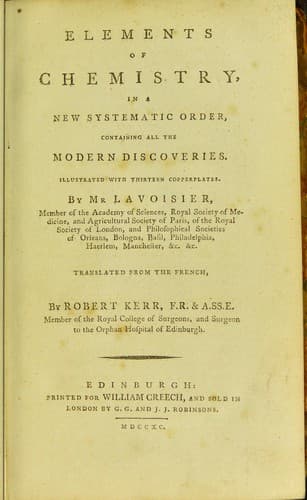
Elements of Chemistry,: In a New Systematic Order, Containing all the Modern DiscoveriesLavoisier, Antoine Laurent
Science
Elements of Chemistry,: In a New Systematic Order, Containing all the Modern Discoveries
Lavoisier, Antoine Laurent
Chemistry -- Early works to 1800
We can readily conceive that the degree of heat at which this phenomenon
begins must be different in different bodies. Hence, on purpose to
oxygenate most bodies, especially the greater part of the simple
substances, it is only necessary to expose them to the influence of the
air of the atmosphere in a convenient degree of temperature. With
respect to lead, mercury, and tin, this needs be but little higher than
the medium temperature of the earth; but it requires a more considerable
degree of heat to oxygenate iron, copper, &c. by the dry way, or when
this operation is not assisted by moisture. Sometimes oxygenation takes
place with great rapidity, and is accompanied by great sensible heat,
light, and flame; such is the combustion of phosphorus in atmospheric
air, and of iron in oxygen gas. That of sulphur is less rapid; and the
oxygenation of lead, tin, and most of the metals, takes place vastly
slower, and consequently the disengagement of caloric, and more
especially of light, is hardly sensible.
Some substances have so strong an affinity with oxygen, and combine with
it in such low degrees of temperature, that we cannot procure them in
their unoxygenated state; such is the muriatic acid, which has not
hitherto been decomposed by art, perhaps even not by nature, and which
consequently has only been found in the state of acid. It is probable
that many other substances of the mineral kingdom are necessarily
oxygenated in the common temperature of the atmosphere, and that being
already saturated with oxygen, prevents their farther action upon that
element.
There are other means of oxygenating simple substances besides exposure
to air in a certain degree of temperature, such as by placing them in
contact with metals combined with oxygen, and which have little affinity
with that element. The red oxyd of mercury is one of the best substances
for this purpose, especially with bodies which do not combine with that
metal. In this oxyd the oxygen is united with very little force to the
metal, and can be driven out by a degree of heat only sufficient to make
glass red hot; wherefore such bodies as are capable of uniting with
oxygen are readily oxygenated, by means of being mixed with red oxyd of
mercury, and moderately heated. The same effect may be, to a certain
degree, produced by means of the black oxyd of manganese, the red oxyd
of lead, the oxyds of silver, and by most of the metallic oxyds, if we
only take care to choose such as have less affinity with oxygen than the
bodies they are meant to oxygenate. All the metallic reductions and
revivifications belong to this class of operations, being nothing more
than oxygenations of charcoal, by means of the several metallic oxyds.
The charcoal combines with the oxygen and with caloric, and escapes in
form of carbonic acid gas, while the metal remains pure and revivified,
or deprived of the oxygen which before combined with it in the form of
oxyd.
Public-domain text, read in full here on John Shaqi.
Reviews
Reviews
No reviews yet
Be the first to share your thoughts on this work.
Elsewhere in the archive
Join the Discussion
Join the discussion
Sign in to leave a comment or review.
Sign InorCreate an account