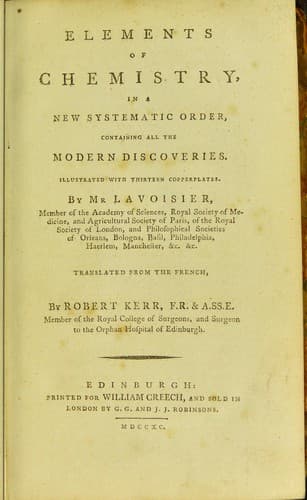
Elements of Chemistry,: In a New Systematic Order, Containing all the Modern DiscoveriesLavoisier, Antoine Laurent
Science
Elements of Chemistry,: In a New Systematic Order, Containing all the Modern Discoveries
Lavoisier, Antoine Laurent
Chemistry -- Early works to 1800
As the combinations of these substances, either with each other, or with
the other combustible bodies, are hitherto entirely unknown, we have
not attempted to form any table for their nomenclature. We only know
that these radicals are susceptible of oxygenation, and of forming the
muriatic, fluoric, and boracic acids, and that in the acid state they
enter into a number of combinations, to be afterwards detailed.
Chemistry has hitherto been unable to disoxygenate any of them, so as to
produce them in a simple state. For this purpose, some substance must be
employed to which oxygen has a stronger affinity than to their radicals,
either by means of single affinity, or by double elective attraction.
All that is known relative to the origin of the radicals of these acids
will be mentioned in the sections set apart for considering their
combinations with the salifiable bases.
SECT. XII.--_Observations upon the Combinations of Metals with each
other._
Before closing our account of the simple or elementary substances, it
might be supposed necessary to give a table of alloys or combinations of
metals with each other; but, as such a table would be both exceedingly
voluminous and very unsatisfactory, without going into a series of
experiments not yet attempted, I have thought it adviseable to omit it
altogether. All that is necessary to be mentioned is, that these alloys
should be named according to the metal in largest proportion in the
mixture or combination; thus the term _alloy of gold and silver_, or
gold alloyed with silver, indicates that gold is the predominating
metal.
Metallic alloys, like all other combinations, have a point of
saturation. It would even appear, from the experiments of Mr de la
Briche, that they have two perfectly distinct degrees of saturation.
TABLE _of the Combinations of Azote in the state of Nitrous Acid with
the Salifiable Bases, arranged according to the affinities of these
Bases with the Acid_.
_Names of the bases._ _Names of the neutral salts._
_New nomenclature._ _Notes._
Barytes Nitrite of barytes. {
Potash potash. { These salts are only
Soda soda. { known of late, and
Lime lime. { have received no particular
Magnesia magnesia. { name in the old
Ammoniac ammoniac. { nomenclature.
Argill argill. {
Public-domain text, read in full here on John Shaqi.
Reviews
Reviews
No reviews yet
Be the first to share your thoughts on this work.
Elsewhere in the archive
Join the Discussion
Join the discussion
Sign in to leave a comment or review.
Sign InorCreate an account