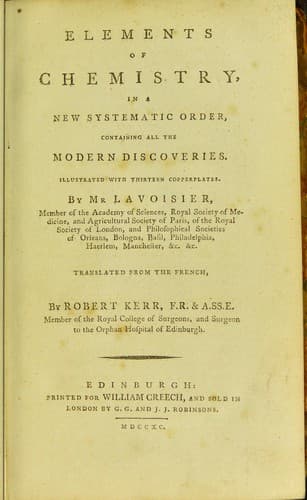
Elements of Chemistry,: In a New Systematic Order, Containing all the Modern DiscoveriesLavoisier, Antoine Laurent
Science
Elements of Chemistry,: In a New Systematic Order, Containing all the Modern Discoveries
Lavoisier, Antoine Laurent
Chemistry -- Early works to 1800
In the manufactories for making sulphuric acid in the large way, the
mixture of nitre and sulphur is burnt in large close built chambers
lined with lead, having a little water at the bottom for facilitating
the condensation of the vapours. Afterwards, by distillation in large
retorts with a gentle heat, the water passes over, slightly impregnated
with acid, and the sulphuric acid remains behind in a concentrated
state. It is then pellucid, without any flavour, and nearly double the
weight of an equal bulk of water. This process would be greatly
facilitated, and the combustion much prolonged, by introducing fresh air
into the chambers, by means of several pairs of bellows directed towards
the flame of the sulphur, and by allowing the nitrous gas to escape
through long serpentine canals, in contact with water, to absorb any
sulphuric or sulphurous acid gas it might contain.
By one experiment, Mr Berthollet found that 69 parts of sulphur in
combustion, united with 31 parts of oxygen, to form 100 parts of
sulphuric acid; and, by another experiment, made in a different manner,
he calculates that 100 parts of sulphuric acid consists of 72 parts
sulphur, combined with 28 parts of oxygen, all by weight.
This acid, in common with every other, can only dissolve metals when
they have been previously oxydated; but most of the metals are capable
of decomposing a part of the acid, so as to carry off a sufficient
quantity of oxygen, to render themselves soluble in the part of the acid
which remains undecomposed. This happens with silver, mercury, iron, and
zinc, in boiling concentrated sulphuric acid; they become first
oxydated by decomposing part of the acid, and then dissolve in the other
part; but they do not sufficiently disoxygenate the decomposed part of
the acid to reconvert it into sulphur; it is only reduced to the state
of sulphurous acid, which, being volatilised by the heat, flies off in
form of sulphurous acid gas.
Silver, mercury, and all the other metals except iron and zinc, are
insoluble in diluted sulphuric acid, because they have not sufficient
affinity with oxygen to draw it off from its combination either with the
sulphur, the sulphurous acid, or the hydrogen; but iron and zinc, being
assisted by the action of the acid, decompose the water, and become
oxydated at its expence, without the help of heat.
TABLE _of the Combinations of the Sulphurous Acid with the Salifiable
Bases, in the order of affinity._
_Names of the Bases._ _Names of the Neutral Salts._
Public-domain text, read in full here on John Shaqi.
Reviews
Reviews
No reviews yet
Be the first to share your thoughts on this work.
Elsewhere in the archive
Join the Discussion
Join the discussion
Sign in to leave a comment or review.
Sign InorCreate an account