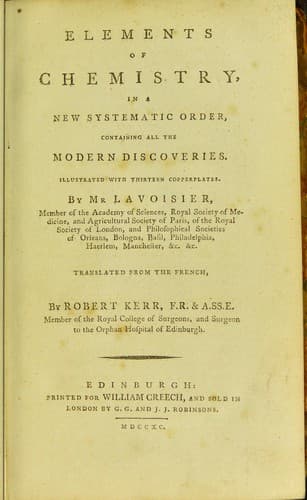
Elements of Chemistry,: In a New Systematic Order, Containing all the Modern DiscoveriesLavoisier, Antoine Laurent
Science
Elements of Chemistry,: In a New Systematic Order, Containing all the Modern Discoveries
Lavoisier, Antoine Laurent
Chemistry -- Early works to 1800
_Names of the Bases._ _Names of the Neutral Salts._
Lime Fluat of lime.
Barytes barytes.
Magnesia magnesia.
Potash potash.
Soda soda.
Ammoniac ammoniac.
Oxyd of
zinc zinc.
manganese manganese.
iron iron.
lead lead.
tin tin.
cobalt cobalt.
copper copper.
nickel nickel.
arsenic arsenic.
bismuth bismuth.
mercury mercury.
silver silver.
gold gold.
platina platina.
And by the dry way,
Argill Fluat of argill.
_Note._--These combinations were entirely unknown to the old chemists,
and consequently have no names in the old nomenclature.--A.
SECT. XXI.--_Observations upon the Fluoric Acid, and its Combinations._
Fluoric exists ready formed by Nature in the fluoric spars[42], combined
with calcareous earth, so as to form an insoluble neutral salt. To
obtain it disengaged from that combination, fluor spar, or fluat of
lime, is put into a leaden retort, with a proper quantity of sulphuric
acid, a recipient likewise of lead, half full of water, is adapted, and
fire is applied to the retort. The sulphuric acid, from its greater
affinity, expels the fluoric acid which passes over and is absorbed by
the water in the receiver. As fluoric acid is naturally in the gasseous
form in the ordinary temperature, we can receive it in a
pneumato-chemical apparatus over mercury. We are obliged to employ
metallic vessels in this process, because fluoric acid dissolves glass
and silicious earth, and even renders these bodies volatile, carrying
them over with itself in distillation in the gasseous form.
We are indebted to Mr Margraff for our first acquaintance with this
acid, though, as he could never procure it free from combination with a
considerable quantity of silicious earth, he was ignorant of its being
an acid sui generis. The Duke de Liancourt, under the name of Mr
Boulanger, considerably increased our knowledge of its properties; and
Mr Scheele seems to have exhausted the subject. The only thing remaining
is to endeavour to discover the nature of the fluoric radical, of which
we cannot hitherto form any ideas, as the acid does not appear to have
been decomposed in any experiment. It is only by means of compound
affinity that experiments ought to be made with this view, with any
probability of success.
TABLE _of the Combinations of Boracic Acid, with the Salifiable Bases,
in the Order of Affinity._
_Bases._ _Neutral Salts._
Public-domain text, read in full here on John Shaqi.
Reviews
Reviews
No reviews yet
Be the first to share your thoughts on this work.
Elsewhere in the archive
Join the Discussion
Join the discussion
Sign in to leave a comment or review.
Sign InorCreate an account