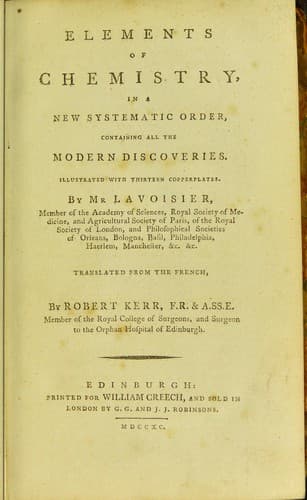
Elements of Chemistry,: In a New Systematic Order, Containing all the Modern DiscoveriesLavoisier, Antoine Laurent
Science
Elements of Chemistry,: In a New Systematic Order, Containing all the Modern Discoveries
Lavoisier, Antoine Laurent
Chemistry -- Early works to 1800
By the specific gravity of any substance is understood the quotient of
its absolute weight divided by its magnitude, or, what is the same, the
weight of a determinate bulk of any body. The weight of a determinate
magnitude of water has been generally assumed as unity for this purpose;
and we express the specific gravity of gold, sulphuric acid, &c. by
saying, that gold is nineteen times, and sulphuric acid twice the weight
of water, and so of other bodies.
It is the more convenient to assume water as unity in specific
gravities, that those substances whose specific gravity we wish to
determine, are most commonly weighed in water for that purpose. Thus, if
we wish to determine the specific gravity of gold flattened under the
hammer, and supposing the piece of gold to weigh 8 oz. 4 gros 2-1/2
grs. in the air[55], it is suspended by means of a fine metallic wire
under the scale of a hydrostatic balance, so as to be entirely immersed
in water, and again weighed. The piece of gold in Mr Brisson's
experiment lost by this means 3 gros 37 grs.; and, as it is evident
that the weight lost by a body weighed in water is precisely equal to
the weight of the water displaced, or to that of an equal volume of
water, we may conclude, that, in equal magnitudes, gold weighs 4893-1/2
grs. and water 253 grs. which, reduced to unity, gives 1.0000 as the
specific gravity of water, and 19.3617 for that of gold. We may operate
in the same manner with all solid substances. We have rarely any
occasion, in chemistry, to determine the specific gravity of solid
bodies, unless when operating upon alloys or metallic glasses; but we
have very frequent necessity to ascertain that of fluids, as it is often
the only means of judging of their purity or degree of concentration.
This object may be very fully accomplished with the hydrostatic balance,
by weighing a solid body; such, for example, as a little ball of rock
cristal suspended by a very fine gold wire, first in the air, and
afterwards in the fluid whose specific gravity we wish to discover. The
weight lost by the cristal, when weighed in the liquor, is equal to that
of an equal bulk of the liquid. By repeating this operation successively
in water and different fluids, we can very readily ascertain, by a
simple and easy calculation, the relative specific gravities of these
fluids, either with respect to each other or to water. This method is
not, however, sufficiently exact, or, at least, is rather troublesome,
from its extreme delicacy, when used for liquids differing but little in
specific gravity from water; such, for instance, as mineral waters, or
any other water containing very small portions of salt in solution.
Public-domain text, read in full here on John Shaqi.
Reviews
Reviews
No reviews yet
Be the first to share your thoughts on this work.
Elsewhere in the archive
Join the Discussion
Join the discussion
Sign in to leave a comment or review.
Sign InorCreate an account