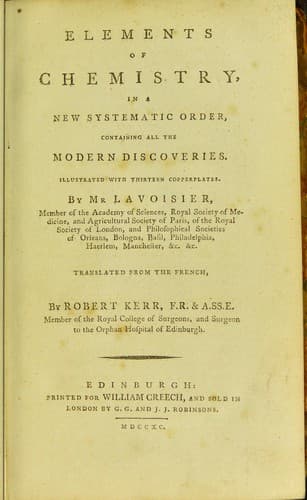
Elements of Chemistry,: In a New Systematic Order, Containing all the Modern DiscoveriesLavoisier, Antoine Laurent
Science
Elements of Chemistry,: In a New Systematic Order, Containing all the Modern Discoveries
Lavoisier, Antoine Laurent
Chemistry -- Early works to 1800
In chemical language, the terms of _solution_ and _dissolution_ have
long been confounded, and have very improperly been indiscriminately
employed for expressing both the division of the particles of a salt in
a fluid, such as water, and the division of a metal in an acid. A few
reflections upon the effects of these two operations will suffice to
show that they ought not to be confounded together. In the solution of
salts, the saline particles are only separated from each other, whilst
neither the salt nor the water are at all decomposed; we are able to
recover both the one and the other in the same quantity as before the
operation. The same thing takes place in the solution of resins in
alkohol. During metallic dissolutions, on the contrary, a decomposition,
either of the acid, or of the water which dilutes it, always takes
place; the metal combines with oxygen, and is changed into an oxyd, and
a gasseous substance is disengaged; so that in reality none of the
substances employed remain, after the operation, in the same state they
were in before. This article is entirely confined to the consideration
of solution.
To understand properly what takes place during the solution of salts, it
is necessary to know, that, in most of these operations, two distinct
effects are complicated together, viz. solution by water, and solution
by caloric; and, as the explanation of most of the phenomena of solution
depends upon the distinction of these two circumstances, I shall enlarge
a little upon their nature.
Nitrat of potash, usually called nitre or saltpetre, contains very
little water of cristallization, perhaps even none at all; yet this salt
liquifies in a degree of heat very little superior to that of boiling
water. This liquifaction cannot therefore be produced by means of the
water of cristallization, but in consequence of the salt being very
fusible in its nature, and from its passing from the solid to the liquid
state of aggregation, when but a little raised above the temperature of
boiling water. All salts are in this manner susceptible of being
liquified by caloric, but in higher or lower degrees of temperature.
Some of these, as the acetites of potash and soda, liquify with a very
moderate heat, whilst others, as sulphat of potash, lime, &c. require
the strongest fires we are capable of producing. This liquifaction of
salts by caloric produces exactly the same phenomena with the melting of
ice; it is accomplished in each salt by a determinate degree of heat,
which remains invariably the same during the whole time of the
liquifaction. Caloric is employed, and becomes fixed during the melting
of the salt, and is, on the contrary, disengaged when the salt
coagulates. These are general phenomena which universally occur during
the passage of every species of substance from the solid to the fluid
state of aggregation, and from fluid to solid.
Public-domain text, read in full here on John Shaqi.
Reviews
Reviews
No reviews yet
Be the first to share your thoughts on this work.
Elsewhere in the archive
Join the Discussion
Join the discussion
Sign in to leave a comment or review.
Sign InorCreate an account