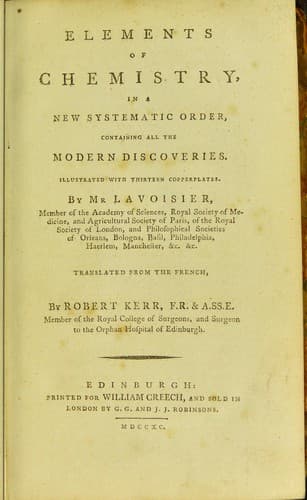
Elements of Chemistry,: In a New Systematic Order, Containing all the Modern DiscoveriesLavoisier, Antoine Laurent
Science
Elements of Chemistry,: In a New Systematic Order, Containing all the Modern Discoveries
Lavoisier, Antoine Laurent
Chemistry -- Early works to 1800
In the formation of water, two substances, hydrogen and oxygen, which
are both in the aeriform state before combustion, are transformed into
liquid or water by the operation. This experiment would be very easy,
and would require very simple instruments, if it were possible to
procure the two gasses perfectly pure, so that they might burn without
any residuum. We might, in that case, operate in very small vessels,
and, by continually furnishing the two gasses in proper proportions,
might continue the combustion indefinitely. But, hitherto, chemists have
only employed oxygen gas, mixed with azotic gas; from which
circumstance, they have only been able to keep up the combustion of
hydrogen gas for a very limited time in close vessels, because, as the
residuum of azotic gas is continually increasing, the air becomes at
last so much contaminated, that the flame weakens and goes out. This
inconvenience is so much the greater in proportion as the oxygen gas
employed is less pure. From this circumstance, we must either be
satisfied with operating upon small quantities, or must exhaust the
vessels at intervals, to get rid of the residuum of azotic gas; but, in
this case, a portion of the water formed during the experiment is
evaporated by the exhaustion; and the resulting error is the more
dangerous to the accuracy of the process, that we have no certain means
of valuing it.
These considerations make me desirous to repeat the principal
experiments of pneumatic chemistry with oxygen gas entirely free from
any admixture of azotic gas; and this may be procured from oxygenated
muriat of potash. The oxygen gas extracted from this salt does not
appear to contain azote, unless accidentally, so that, by proper
precautions, it may be obtained perfectly pure. In the mean time, the
apparatus employed by Mr Meusnier and me for the combustion of hydrogen
gas, which is described in the experiment for recomposition of water,
Part I. Chap. VIII. and need not be here repeated, will answer the
purpose; when pure gasses are procured, this apparatus will require no
alterations, except that the capacity of the vessels may then be
diminished. See Pl. IV. Fig. 5.
The combustion, when once begun, continues for a considerable time, but
weakens gradually, in proportion as the quantity of azotic gas remaining
from the combustion increases, till at last the azotic gas is in such
over proportion that the combustion can no longer be supported, and the
flame goes out. This spontaneous extinction must be prevented, because,
as the hydrogen gas is pressed upon in its reservoir, by an inch and a
half of water, whilst the oxygen gas suffers a pressure only of three
lines, a mixture of the two would take place in the balloon, which would
at last be forced by the superior pressure into the reservoir of oxygen
gas. Wherefore the combustion must be stopped, by shutting the
stop-cock of the tube dDd whenever the flame grows very feeble; for
which purpose it must be attentively watched.
Public-domain text, read in full here on John Shaqi.
Reviews
Reviews
No reviews yet
Be the first to share your thoughts on this work.
Elsewhere in the archive
Join the Discussion
Join the discussion
Sign in to leave a comment or review.
Sign InorCreate an account