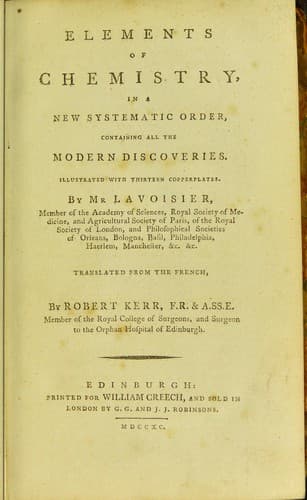
Elements of Chemistry,: In a New Systematic Order, Containing all the Modern Discoveries — John Shaqi
Elements of Chemistry,: In a New Systematic Order, Containing all the Modern DiscoveriesLavoisier, Antoine Laurent
Science
Elements of Chemistry,: In a New Systematic Order, Containing all the Modern Discoveries
Lavoisier, Antoine Laurent
Chemistry -- Early works to 1800
Having established these clear and simple propositions, it will be very
easy to explain the ideas which ought to be affixed to the following
expressions, which are by no means synonimous, but possess each a strict
and determinate meaning, as in the following definitions:
_Free caloric_, is that which is not combined in any manner with any
other body. But, as we live in a system to which caloric has a very
strong adhesion, it follows that we are never able to obtain it in the
state of absolute freedom.
_Combined caloric_, is that which is fixed in bodies by affinity or
elective attraction, so as to form part of the substance of the body,
even part of its solidity.
By the expression _specific caloric_ of bodies, we understand the
respective quantities of caloric requisite for raising a number of
bodies of the same weight to an equal degree of temperature. This
proportional quantity of caloric depends upon the distance between the
constituent particles of bodies, and their greater or lesser degrees of
cohesion; and this distance, or rather the space or void resulting from
it, is, as I have already observed, called the _capacity of bodies for
containing caloric_.
_Heat_, considered as a sensation, or, in other words, sensible heat, is
only the effect produced upon our sentient organs, by the motion or
passage of caloric, disengaged from the surrounding bodies. In general,
we receive impressions only in consequence of motion, and we might
establish it as an axiom, _That_, WITHOUT MOTION, THERE IS NO SENSATION.
This general principle applies very accurately to the sensations of heat
and cold: When we touch a cold body, the caloric which always tends to
become in equilibrio in all bodies, passes from our hand into the body
we touch, which gives us the feeling or sensation of cold. The direct
contrary happens, when we touch a warm body, the caloric then passing
from the body into our hand, produces the sensation of heat. If the hand
and the body touched be of the same temperature, or very nearly so, we
receive no impression, either of heat or cold, because there is no
motion or passage of caloric; and thus no sensation can take place,
without some correspondent motion to occasion it.
When the thermometer rises, it shows, that free caloric is entering into
the surrounding bodies: The thermometer, which is one of these, receives
its share in proportion to its mass, and to the capacity which it
possesses for containing caloric. The change therefore which takes place
upon the thermometer, only announces a change of place of the caloric
in those bodies, of which the thermometer forms one part; it only
indicates the portion of caloric received, without being a measure of
the whole quantity disengaged, displaced, or absorbed.
Public-domain text, read in full here on John Shaqi.
Reviews
Reviews
No reviews yet
Be the first to share your thoughts on this work.
Join the Discussion
Join the discussion
Sign in to leave a comment or review.
Sign InorCreate an account