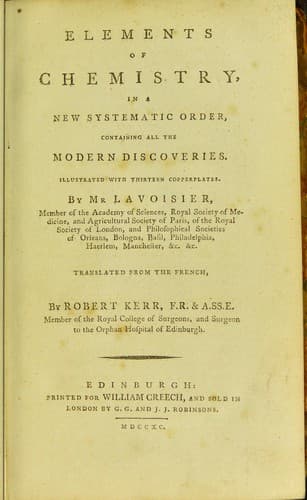
Elements of Chemistry,: In a New Systematic Order, Containing all the Modern DiscoveriesLavoisier, Antoine Laurent
Science
Elements of Chemistry,: In a New Systematic Order, Containing all the Modern Discoveries
Lavoisier, Antoine Laurent
Chemistry -- Early works to 1800
We have this advantage in the analysis of atmospherical air, being able
both to decompound it, and to form it a new in the most satisfactory
manner. I shall, however, at present confine myself to recount such
experiments as are most conclusive upon this head; and I may consider
most of these as my own, having either first invented them, or having
repeated those of others, with the intention of analysing atmospherical
air, in perfectly new points of view.
I took a matrass (A, fig. 14. plate II.) of about 36 cubical inches
capacity, having a long neck B C D E, of six or seven lines internal
diameter, and having bent the neck as in Plate IV. Fig. 2. so as to
allow of its being placed in the furnace M M N N, in such a manner that
the extremity of its neck E might be inserted under a bell-glass F G,
placed in a trough of quicksilver R R S S; I introduced four ounces of
pure mercury into the matrass, and, by means of a syphon, exhausted the
air in the receiver F G, so as to raise the quicksilver to L L, and I
carefully marked the height at which it stood by pasting on a slip of
paper. Having accurately noted the height of the thermometer and
barometer, I lighted a fire in the furnace M M N N, which I kept up
almost continually during twelve days, so as to keep the quicksilver
always almost at its boiling point. Nothing remarkable took place during
the first day: The Mercury, though not boiling, was continually
evaporating, and covered the interior surface of the vessels with small
drops, at first very minute, which gradually augmenting to a sufficient
size, fell back into the mass at the bottom of the vessel. On the second
day, small red particles began to appear on the surface of the mercury,
which, during the four or five following days, gradually increased in
size and number; after which they ceased to increase in either respect.
At the end of twelve days, seeing that the calcination of the mercury
did not at all increase, I extinguished the fire, and allowed the
vessels to cool. The bulk of air in the body and neck of the matrass,
and in the bell-glass, reduced to a medium of 28 inches of the
barometer and 10 deg. (54.5 deg.) of the thermometer, at the commencement
of the experiment was about 50 cubical inches. At the end of the
experiment the remaining air, reduced to the same medium pressure and
temperature, was only between 42 and 43 cubical inches; consequently it
had lost about 1/6 of its bulk. Afterwards, having collected all the
red particles, formed during the experiment, from the running mercury
in which they floated, I found these to amount to 45 grains.
Public-domain text, read in full here on John Shaqi.
Reviews
Reviews
No reviews yet
Be the first to share your thoughts on this work.
Join the Discussion
Join the discussion
Sign in to leave a comment or review.
Sign InorCreate an account