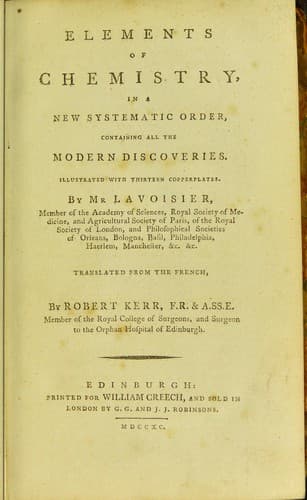
Elements of Chemistry,: In a New Systematic Order, Containing all the Modern DiscoveriesLavoisier, Antoine Laurent
Science
Elements of Chemistry,: In a New Systematic Order, Containing all the Modern Discoveries
Lavoisier, Antoine Laurent
Chemistry -- Early works to 1800
I was obliged to repeat this experiment several times, as it is
difficult in one experiment both to preserve the whole air upon which we
operate, and to collect the whole of the red particles, or calx of
mercury, which is formed during the calcination. It will often happen in
the sequel, that I shall, in this manner, give in one detail the results
of two or three experiments of the same nature.
The air which remained after the calcination of the mercury in this
experiment, and which was reduced to 5/6 of its former bulk, was no
longer fit either for respiration or for combustion; animals being
introduced into it were suffocated in a few seconds, and when a taper
was plunged into it, it was extinguished as if it had been immersed into
water.
In the next place, I took the 45 grains of red matter formed during this
experiment, which I put into a small glass retort, having a proper
apparatus for receiving such liquid, or gasseous product, as might be
extracted: Having applied a fire to the retort in a furnace, I observed
that, in proportion as the red matter became heated, the intensity of
its colour augmented. When the retort was almost red hot, the red matter
began gradually to decrease in bulk, and in a few minutes after it
disappeared altogether; at the same time 41-1/2 grains of running
mercury were collected in the recipient, and 7 or 8 cubical inches of
elastic fluid, greatly more capable of supporting both respiration and
combustion than atmospherical air, were collected in the bell-glass.
A part of this air being put into a glass tube of about an inch
diameter, showed the following properties: A taper burned in it with a
dazzling splendour, and charcoal, instead of consuming quietly as it
does in common air, burnt with a flame, attended with a decrepitating
noise, like phosphorus, and threw out such a brilliant light that the
eyes could hardly endure it. This species of air was discovered almost
at the same time by Mr Priestley, Mr Scheele, and myself. Mr Priestley
gave it the name of _dephlogisticated air_, Mr Scheele called it
_empyreal air_. At first I named it _highly respirable air_, to which
has since been substituted the term of _vital air_. We shall presently
see what we ought to think of these denominations.
Public-domain text, read in full here on John Shaqi.
Reviews
Reviews
No reviews yet
Be the first to share your thoughts on this work.
Join the Discussion
Join the discussion
Sign in to leave a comment or review.
Sign InorCreate an account