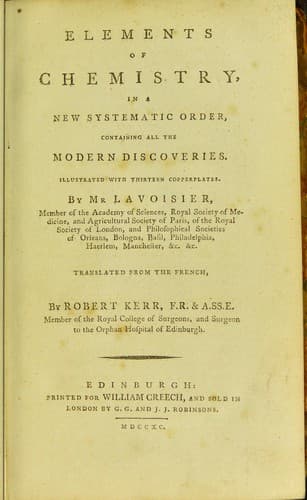
Elements of Chemistry,: In a New Systematic Order, Containing all the Modern DiscoveriesLavoisier, Antoine Laurent
Science
Elements of Chemistry,: In a New Systematic Order, Containing all the Modern Discoveries
Lavoisier, Antoine Laurent
Chemistry -- Early works to 1800
Hitherto I have been obliged to make use of circumlocution, to express
the nature of the several substances which constitute our atmosphere,
having provisionally used the terms of _respirable_ and _noxious_, or
_non-respirable parts of the air_. But the investigations I mean to
undertake require a more direct mode of expression; and, having now
endeavoured to give simple and distinct ideas of the different
substances which enter into the composition of the atmosphere, I shall
henceforth express these ideas by words equally simple.
The temperature of our earth being very near to that at which water
becomes solid, and reciprocally changes from solid to fluid, and as this
phenomenon takes place frequently under our observation, it has very
naturally followed, that, in the languages of at least every climate
subjected to any degree of winter, a term has been used for signifying
water in the state of solidity, when deprived of its caloric. The same,
however, has not been found necessary with respect to water reduced to
the state of vapour by an additional dose of caloric; since those
persons who do not make a particular study of objects of this kind, are
still ignorant that water, when in a temperature only a little above the
boiling heat, is changed into an elastic aeriform fluid, susceptible,
like all other gasses, of being received and contained in vessels, and
preserving its gasseous form so long as it remains at the temperature of
80 deg. (212 deg.), and under a pressure not exceeding 28 inches of the
mercurial barometer. As this phenomenon has not been generally observed,
no language has used a particular term for expressing water in this
state[10]; and the same thing occurs with all fluids, and all
substances, which do not evaporate in the common temperature, and under
the usual pressure of our atmosphere.
For similar reasons, names have not been given to the liquid or concrete
states of most of the aeriform fluids: These were not known to arise
from the combination of caloric with certain bases; and, as they had not
been seen either in the liquid or solid states, their existence, under
these forms, was even unknown to natural philosophers.
Public-domain text, read in full here on John Shaqi.
Reviews
Reviews
No reviews yet
Be the first to share your thoughts on this work.
Elsewhere in the archive
Join the Discussion
Join the discussion
Sign in to leave a comment or review.
Sign InorCreate an account