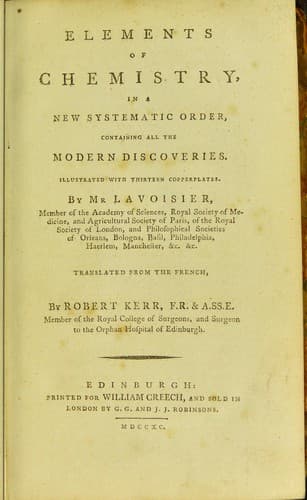
Elements of Chemistry,: In a New Systematic Order, Containing all the Modern DiscoveriesLavoisier, Antoine Laurent
Science
Elements of Chemistry,: In a New Systematic Order, Containing all the Modern Discoveries
Lavoisier, Antoine Laurent
Chemistry -- Early works to 1800
I mentioned before, that we have two ways of determining the constituent
parts of atmospheric air, the method of analysis, and that by synthesis.
The calcination of mercury has furnished us with an example of each of
these methods, since, after having robbed the respirable part of its
base, by means of the mercury, we have restored it, so as to recompose
an air precisely similar to that of the atmosphere. But we can equally
accomplish this synthetic composition of atmospheric air, by borrowing
the materials of which it is composed from different kingdoms of nature.
We shall see hereafter that, when animal substances are dissolved in the
nitric acid, a great quantity of gas is disengaged, which extinguishes
light, and is unfit for animal respiration, being exactly similar to the
noxious or mephitic part of atmospheric air. And, if we take 73 parts,
by weight, of this elastic fluid, and mix it with 27 parts of highly
respirable air, procured from calcined mercury, we will form an elastic
fluid precisely similar to atmospheric air in all its properties.
There are many other methods of separating the respirable from the
noxious part of the atmospheric air, which cannot be taken notice of in
this part, without anticipating information, which properly belongs to
the subsequent chapters. The experiments already adduced may suffice for
an elementary treatise; and, in matters of this nature, the choice of
our evidences is of far greater consequence than their number.
I shall close this article, by pointing out the property which
atmospheric air, and all the known gasses, possess of dissolving water,
which is of great consequence to be attended to in all experiments of
this nature. Mr Saussure found, by experiment, that a cubical foot of
atmospheric air is capable of holding 12 grains of water in solution:
Other gasses, as the carbonic acid, appear capable of dissolving a
greater quantity; but experiments are still wanting by which to
determine their several proportions. This water, held in solution by
gasses, gives rise to particular phenomena in many experiments, which
require great attention, and which has frequently proved the source of
great errors to chemists in determining the results of their
experiments.
FOOTNOTES:
[9] It will likewise be necessary to take care that the air contained in
the glass, both before and after the experiment, be reduced to a common
temperature and pressure, otherwise the results of the following
calculations will be fallacious.--E.
CHAP. IV.
_Nomenclature of the several Constituent Parts of Atmospheric Air._
Public-domain text, read in full here on John Shaqi.
Reviews
Reviews
No reviews yet
Be the first to share your thoughts on this work.
Elsewhere in the archive
Join the Discussion
Join the discussion
Sign in to leave a comment or review.
Sign InorCreate an account