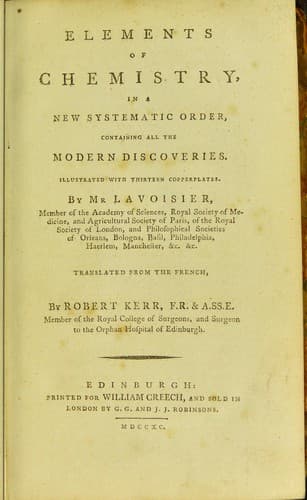
Elements of Chemistry,: In a New Systematic Order, Containing all the Modern DiscoveriesLavoisier, Antoine Laurent
Science
Elements of Chemistry,: In a New Systematic Order, Containing all the Modern Discoveries
Lavoisier, Antoine Laurent
Chemistry -- Early works to 1800
Having filled a bell-glass (A. Pl. iv. fig. 3), of between five and six
pints measure, with oxygen gas, I removed it from the water trough,
where it was filled, into the quicksilver bath, by means of a shallow
glass dish slipped underneath, and having dried the mercury, I
introduced 61-1/4 grains of Kunkel's phosphorus in two little China
cups, like that represented at D, fig. 3. under the glass A; and that I
might set fire to each of the portions of phosphorus separately, and to
prevent the one from catching fire from the other, one of the dishes was
covered with a piece of flat glass. I next raised the quicksilver in the
bell-glass up to E F, by sucking out a sufficient portion of the gas by
means of the syphon G H I. After this, by means of the crooked iron wire
(fig. 16.), made red hot, I set fire to the two portions of phosphorus
successively, first burning that portion which was not covered with the
piece of glass. The combustion was extremely rapid, attended with a very
brilliant flame, and considerable disengagement of light and heat. In
consequence of the great heat induced, the gas was at first much
dilated, but soon after the mercury returned to its level, and a
considerable absorption of gas took place; at the same time, the whole
inside of the glass became covered with white light flakes of concrete
phosphoric acid.
At the beginning of the experiment, the quantity of oxygen gas, reduced,
as above directed, to a common standard, amounted to 162 cubical inches;
and, after the combustion was finished, only 23-1/4 cubical inches,
likewise reduced to the standard, remained; so that the quantity of
oxygen gas absorbed during the combustion was 138-3/4 cubical inches,
equal to 69.375 grains.
A part of the phosphorus remained unconsumed in the bottom of the cups,
which being washed on purpose to separate the acid, weighed about 16-1/4
grains; so that about 45 grains of phosphorus had been burned: But, as
it is hardly possible to avoid an error of one or two grains, I leave
the quantity so far qualified. Hence, as nearly 45 grains of phosphorus
had, in this experiment, united with 69.375 grains of oxygen, and as no
gravitating matter could have escaped through the glass, we have a right
to conclude, that the weight of the substance resulting from the
combustion in form of white flakes, must equal that of the phosphorus
and oxygen employed, which amounts to 114.375 grains. And we shall
presently find, that these flakes consisted entirely of a solid or
concrete acid. When we reduce these weights to hundredth parts, it will
be found, that 100 parts of phosphorus require 154 parts of oxygen for
saturation, and that this combination will produce 254 parts of concrete
phosphoric acid, in form of white fleecy flakes.
Public-domain text, read in full here on John Shaqi.
Reviews
Reviews
No reviews yet
Be the first to share your thoughts on this work.
Elsewhere in the archive
Join the Discussion
Join the discussion
Sign in to leave a comment or review.
Sign InorCreate an account