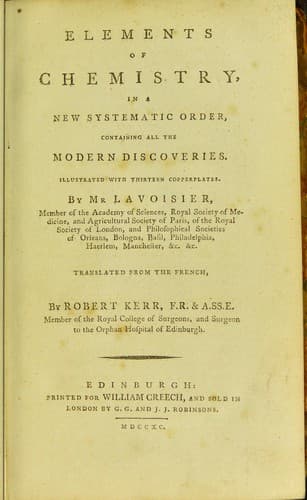
Elements of Chemistry,: In a New Systematic Order, Containing all the Modern DiscoveriesLavoisier, Antoine Laurent
Science
Elements of Chemistry,: In a New Systematic Order, Containing all the Modern Discoveries
Lavoisier, Antoine Laurent
Chemistry -- Early works to 1800
There is however, a remarkable circumstance in the oxygenation of
combustible bodies, and of a part of such bodies as are convertible into
acids, that they are susceptible of different degrees of saturation with
oxygen, and that the resulting acids, though formed by the union of the
same elements, are possessed of different properties, depending upon
that difference of proportion. Of this, the phosphoric acid, and more
especially the sulphuric, furnishes us with examples. When sulphur is
combined with a small proportion of oxygen, it forms, in this first or
lower degree of oxygenation, a volatile acid, having a penetrating
odour, and possessed of very particular qualities. By a larger
proportion of oxygen, it is changed into a fixed, heavy acid, without
any odour, and which, by combination with other bodies, gives products
quite different from those furnished by the former. In this instance,
the principles of our nomenclature seem to fail; and it seems difficult
to derive such terms from the name of the acidifiable base, as shall
distinctly express these two degrees of saturation, or oxygenation,
without circumlocution. By reflection, however, upon the subject, or
perhaps rather from the necessity of the case, we have thought it
allowable to express these varieties in the oxygenation of the acids, by
simply varying the termination of their specific names. The volatile
acid produced from sulphur was anciently known to Stahl under the name
of _sulphurous_ acid[12]. We have preserved that term for this acid
from sulphur under-saturated with oxygen; and distinguish the other, or
completely saturated or oxygenated acid, by the name of _sulphuric_
acid. We shall therefore say, in this new chemical language, that
sulphur, in combining with oxygen, is susceptible of two degrees of
saturation; that the first, or lesser degree, constitutes sulphurous
acid, which is volatile and penetrating; whilst the second, or higher
degree of saturation, produces sulphuric acid, which is fixed and
inodorous. We shall adopt this difference of termination for all the
acids which assume several degrees of saturation. Hence we have a
phosphorous and a phosphoric acid, an acetous and an acetic acid; and so
on, for others in similar circumstances.
Public-domain text, read in full here on John Shaqi.
Reviews
Reviews
No reviews yet
Be the first to share your thoughts on this work.
Elsewhere in the archive
Join the Discussion
Join the discussion
Sign in to leave a comment or review.
Sign InorCreate an account