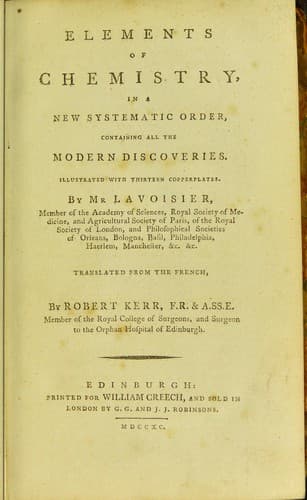
Elements of Chemistry,: In a New Systematic Order, Containing all the Modern DiscoveriesLavoisier, Antoine Laurent
Science
Elements of Chemistry,: In a New Systematic Order, Containing all the Modern Discoveries
Lavoisier, Antoine Laurent
Chemistry -- Early works to 1800
I shall finish this chapter by an experiment much less demonstrative
than those already related, but which has appeared to make more
impression than any other upon the minds of many people. When 16 ounces
of alkohol are burnt in an apparatus[21] properly adapted for collecting
all the water disengaged during the combustion, we obtain from 17 to 18
ounces of water. As no substance can furnish a product larger than its
original bulk, it follows, that something else has united with the
alkohol during its combustion; and I have already shown that this must
be oxygen, or the base of air. Thus alkohol contains hydrogen, which is
one of the elements of water; and the atmospheric air contains oxygen,
which is the other element necessary to the composition of water. This
experiment is a new proof that water is a compound substance.
FOOTNOTES:
[16] In the latter part of this work will be found a particular account
of the processes necessary for separating the different kinds of gasses,
and for determining their quantities.--A.
[17] This expression Hydrogen has been very severely criticised by some,
who pretend that it signifies engendered by water, and not that which
engenders water. The experiments related in this chapter prove, that,
when water is decomposed, hydrogen is produced, and that, when hydrogen
is combined with oxygen, water is produced: So that we may say, with
equal truth, that water is produced from hydrogen, or hydrogen is
produced from water.--A.
[18] See the nature of these salts in the second part of this book.--A.
[19] By potash is here meant, pure or caustic alkali, deprived of
carbonic acid by means of quick-lime: In general, we may observe here,
that all the alkalies and earths must invariably be considered as in
their pure or caustic state, unless otherwise expressed.--E. The method
of obtaining this pure alkali of potash will be given in the sequel.--A.
[20] See the third part of this work.--A.
[21] See an account of this apparatus in the third part of this
work.--A.
CHAP. IX.
_Of the quantities of Caloric disengaged from different species of
Combustion._
We have already mentioned, that, when any body is burnt in the center of
a hollow sphere of ice and supplied with air at the temperature of zero
(32 deg.), the quantity of ice melted from the inside of the sphere
becomes a measure of the relative quantities of caloric disengaged. Mr
de la Place and I gave a description of the apparatus employed for this
kind of experiment in the Memoirs of the Academy for 1780, p. 355; and a
description and plate of the same apparatus will be found in the third
part of this work. With this apparatus, phosphorus, charcoal, and
hydrogen gas, gave the following results:
One pound of phosphorus melted 100 libs. of ice.
One pound of charcoal melted 96 libs. 8 oz.
One pound of hydrogen gas melted 295 libs. 9 oz. 3-1/2 gros.
Public-domain text, read in full here on John Shaqi.
Reviews
Reviews
No reviews yet
Be the first to share your thoughts on this work.
Elsewhere in the archive
Join the Discussion
Join the discussion
Sign in to leave a comment or review.
Sign InorCreate an account