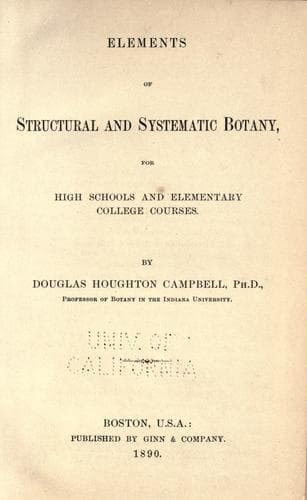
Elements of Structural and Systematic Botany: For High Schools and Elementary College CoursesCampbell, Douglas Houghton
Science
Elements of Structural and Systematic Botany: For High Schools and Elementary College Courses
Campbell, Douglas Houghton
Botany -- Textbooks
The leaves are perfectly smooth, dull purplish red on the lower side,
and pale green with purplish blotches above. The epidermis may be very
easily removed, and is perfectly colorless. Examined closely,
longitudinal rows of whitish spots may be detected: these are the
breathing pores.
[Illustration: FIG. 81.--_A_, plant of the yellow adder-tongue
(_Erythronium americanum_), × ⅓. _B_, the bulb of the same, × ½. _r_,
roots. _C_, section of _B_. _st._ the base of the stem bearing the
bulb for next year (_b_) at its base. _D_, a single petal and stamen,
× ½. _f_, the filament. _an._ anther. _E_, the gynœcium (pistil), × 1.
_o_, ovary. _st._ style. _z_, stigma. _F_, a full-grown fruit, × ½.
_G_, section of a full-grown macrosporangium (ovule), × 25: i, ii, the
two integuments. _sp._ macrospore (embryo sac). _H_, cross-section of
the ripe anther, × 12. _I_, a single pollen spore, × 150, showing the
two nuclei (_n_, _nʹ_). _J_, a ripe seed, × 2. _K_, the same, in
longitudinal section. _em._ the embryo. _L_, cross-section of the
stem, × 12. _fb._ fibro-vascular bundle. _M_, diagram of the flower.]
A cross-section of the stem shows numerous whitish areas scattered
through it. These are the fibro-vascular bundles which in the
monocotyledons are of a simple type. The bulb is composed of thick
scales, which are modified leaves, and on cutting it lengthwise, we
shall probably find the young bulb of next year (Fig. _C_, _b_)
already forming inside it, the young bulb arising as a bud at the
base of the stem of the present year.
The flower is made up of five circles of very much modified leaves,
three leaves in each set. The two outer circles are much alike, but
the three outermost leaves are slightly narrower and strongly tinged
with red on the back, completely concealing the three inner ones
before the flower expands. The latter are pure yellow, except for a
ridge along the back, and a few red specks near the base inside. These
six leaves constitute the perigone of the flower; the three outer are
called sepals, the inner ones petals.
The next two circles are composed of the sporophylls bearing the
pollen spores.[12] These are the stamens, and taken collectively are
known as the "_Andrœcium_." Each leaf or stamen consists of two
distinct portions, a delicate stalk or "filament" (_D_, _f_), and the
upper spore-bearing part, the "anther" (_an._). The anther in the
freshly opened flower has a smooth, red surface; but shortly after,
the flower opens, splits along each side, and discharges the pollen
spores. A section across the anther shows it to be composed of four
sporangia or pollen sacs attached to a common central axis
("connective") (Fig. _H_).
[12] The three outer stamens are shorter than the inner set.
Public-domain text, read in full here on John Shaqi.
Reviews
Reviews
No reviews yet
Be the first to share your thoughts on this work.
Elsewhere in the archive
Join the Discussion
Join the discussion
Sign in to leave a comment or review.
Sign InorCreate an account