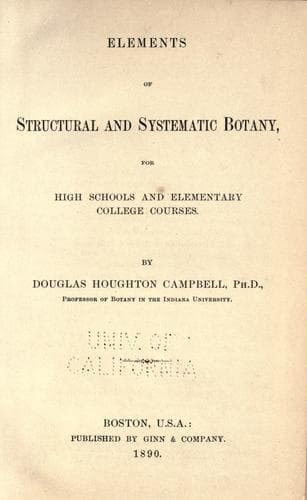
Elements of Structural and Systematic Botany: For High Schools and Elementary College CoursesCampbell, Douglas Houghton
Science
Elements of Structural and Systematic Botany: For High Schools and Elementary College Courses
Campbell, Douglas Houghton
Botany -- Textbooks
As the seed develops, the embryo sac (_G_, _sp._) enlarges so as to
occupy pretty much the whole space of the seed. At first it is
nearly filled with a fluid, but a layer of cells is formed, lining
the walls, and this thickens until the whole space, except what is
occupied by the small embryo, is filled with them. These are called
the "endosperm cells," but differ from the endosperm cells of the
gymnosperms, in the fact that they are not developed until after
fertilization, and can hardly, therefore, be regarded as
representing the prothallium of the gymnosperms and pteridophytes.
These cells finally form a firm tissue, whose cells are filled with
starch that forms a reserve supply of food for the embryo plant when
the seed germinates. The embryo (Fig. 81, _K_, _em._, Fig. 82, _J_),
even when the seed is ripe, remains very small, and shows scarcely
any differentiation. It is a small, pear-shaped mass of cells, the
smaller end directed toward the upper end of the embryo sac.
The integuments grow with the embryo sac, and become brown and hard,
forming the shell of the seed. The stalk of the ovule also enlarges,
and finally forms the peculiar, spongy appendage of the seeds already
noticed (Fig. 81, _J_, _K_).
CHAPTER XVI.
CLASSIFICATION OF THE MONOCOTYLEDONS.
In the following chapter no attempt will be made to give an exhaustive
account of the characteristics of each division of the monocotyledons,
but only such of the most important ones as may serve to supplement
our study of the special one already examined. The classification
here, and this is the case throughout the spermaphytes, is based
mainly upon the characters of the flowers and fruits.
The classification adopted here is that of the German botanist
Eichler, and seems to the author to accord better with our present
knowledge of the relationships of the groups than do the systems that
are more general in this country. According to Eichler's
classification, the monocotyledons may be divided into seven groups;
viz., I. _Liliifloræ_; II. _Enantioblastæ_; III. _Spadicifloræ_;
IV. _Glumaceæ_; V. _Scitamineæ_; VI. _Gynandræ_; VII. _Helobiæ_.
ORDER I.--_Liliifloræ_.
Public-domain text, read in full here on John Shaqi.
Reviews
Reviews
No reviews yet
Be the first to share your thoughts on this work.
Elsewhere in the archive
Join the Discussion
Join the discussion
Sign in to leave a comment or review.
Sign InorCreate an account