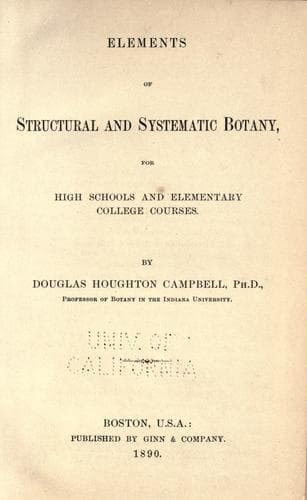
Elements of Structural and Systematic Botany: For High Schools and Elementary College CoursesCampbell, Douglas Houghton
Science
Elements of Structural and Systematic Botany: For High Schools and Elementary College Courses
Campbell, Douglas Houghton
Botany -- Textbooks
The seeds are large, but the embryo is very small. A section of a
nearly ripe seed shows the embryo (_em._) occupying the upper part of
the embryo sac which does not nearly fill the seed and contains no
endosperm. The bulk of the seed is derived from the tissue of the body
of the ovule, which in most seeds becomes entirely obliterated by the
growth of the embryo sac. The cells of this tissue become filled with
starch, and serve the same purpose as the endosperm of other seeds.
This tissue is called "perisperm."
Of food plants belonging to this order, the banana (_Musa_) is much
the most important. Others of more or less value are species of
arrowroot (_Maranta_) and ginger (_Zingiber_).
There are three families: I. _Musaceæ_ (banana family);
II. _Zingiberaceæ_ (ginger family); and III. _Cannaceæ_ (_Canna_,
_Maranta_).
ORDER VI.--_Gynandræ_.
By far the greater number of the plants of this order belong to the
orchis family (_Orchideæ_), the second family of the order
(_Apostasieæ_), being a small one and unrepresented in the United
States. The orchids are in some respects the most highly specialized
of all flowers, and exhibit wonderful variety in the shape and color
of the flowers, which are often of extraordinary beauty, and show
special contrivances for cross-fertilization that are without parallel
among flowering plants.
[Illustration: FIG. 89.--_Gynandræ_. _A_, inflorescence of the showy
orchis (_Orchis spectabilis_), × 1 (_Orchideæ_). _B_, a single flower,
with the upper leaves of the perianth turned back to show the column
(_x_). _sp._ the spur attached to the lower petal or lip. _o_, the
ovary, × 1. _C_, the column seen from in front. _an._ the stamen.
_gy._ the stigmatic surface, × 1. _D_, the two pollen masses attached
to a straw, which was inserted into the flower, by means of the viscid
disc (_d_): i, the masses immediately after their withdrawal; ii, iii,
the same a few minutes later, showing the change in position. _E_,
diagram of the flower; the position of the missing stamens indicated
by small circles.]
Public-domain text, read in full here on John Shaqi.
Reviews
Reviews
No reviews yet
Be the first to share your thoughts on this work.
Elsewhere in the archive
Join the Discussion
Join the discussion
Sign in to leave a comment or review.
Sign InorCreate an account