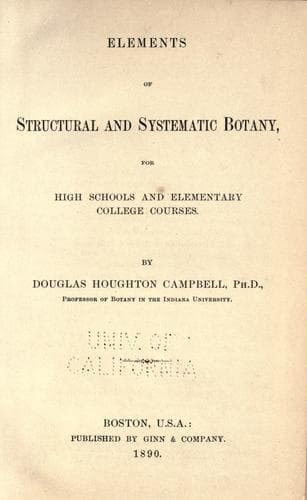
Elements of Structural and Systematic Botany: For High Schools and Elementary College CoursesCampbell, Douglas Houghton
Science
Elements of Structural and Systematic Botany: For High Schools and Elementary College Courses
Campbell, Douglas Houghton
Botany -- Textbooks
Branches are given off from the main stem, arising at the point where
the leaves join the stem (axils of the leaves), and these may in turn
branch. All the branches terminate finally in an elongated
inflorescence, and the separate flowers are attached to the main axis
of the inflorescence by short stalks. This form of inflorescence is
known technically as a "raceme." Each flower is really a short branch
from which the floral leaves arise in precisely the same way as the
foliage leaves do from the ordinary branches. There are five sets of
floral leaves: I. four outer perigone leaves (sepals) (_F_), small,
green, pointed leaves traversed by three simple veins, and together
forming the calyx; II. four larger, white, inner perigone leaves
(petals) (_G_), broad and slightly notched at the end, and tapering to
the point of attachment. The petals collectively are known as the
"corolla." The veins of the petals fork once; III. and IV. two sets of
stamens (_E_), the outer containing two short, and the inner, four
longer ones arranged in pairs. Each stamen has a slender filament
(_H_, _f_) and a two-lobed anther (_an._). The innermost set consists
of two carpels united into a compound pistil. The ovary is oblong,
slightly flattened so as to be oval in section, and divided into two
chambers. The style is very short and tipped by a round, flattened
stigma.
The raceme continues to grow for a long time, forming new flowers at
the end, so that all stages of flowers and fruit may often be found in
the same inflorescence.
The flowers are probably quite independent of insect aid in
pollination, as the stamens are so placed as to almost infallibly shed
their pollen upon the stigma. This fact, probably, accounts for the
inconspicuous character of the flowers.
After fertilization is effected, and the outer floral leaves fall off,
the ovary rapidly enlarges, and becomes heart-shaped and much
flattened at right angles to the partition. When ripe, each half falls
away, leaving the seeds attached by delicate stalks (funiculi, sing.
funiculus) to the edges of the membranous partition. The seeds are
small, oval bodies with a shining, yellow-brown shell, and with a
little dent at the end where the stalk is attached. Carefully dividing
the seed lengthwise, or crushing it in water so as to remove the
embryo, we find it occupies the whole cavity of the seed, the young
stalk (_st._) being bent down against the back of one of the
cotyledons (_f_).
Public-domain text, read in full here on John Shaqi.
Reviews
Reviews
No reviews yet
Be the first to share your thoughts on this work.
Elsewhere in the archive
Join the Discussion
Join the discussion
Sign in to leave a comment or review.
Sign InorCreate an account