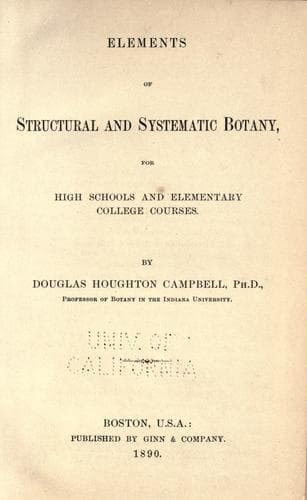
Elements of Structural and Systematic Botany: For High Schools and Elementary College CoursesCampbell, Douglas Houghton
Science
Elements of Structural and Systematic Botany: For High Schools and Elementary College Courses
Campbell, Douglas Houghton
Botany -- Textbooks
The last and highest group of the _Choripetalæ_, the _Calycifloræ_,
embraces a very large assemblage of familiar plants, divided into
eight orders and thirty-two families. With few exceptions, the floral
axis grows up around the ovary, carrying the outer floral leaves above
it, and the ovary appears at the bottom of a cup around whose edge the
other parts of the flower are arranged. Sometimes, as in the fuchsia,
the ovary is grown to the base of the cup or tube, and thus looks as
if it were outside the flower. Such an ovary is said to be "inferior"
in distinction from one that is entirely free from the tube, and thus
is evidently within the flower. The latter is the so-called "superior"
ovary. The carpels are usually united into a compound pistil, but may
be separate, as in the stonecrop (Fig. 111, _E_), or strawberry
(Fig. 114, _C_).
The first order of the _Calycifloræ_ (_Umbellifloræ_) has the flowers
small, and usually arranged in umbels, _i.e._ several stalked flowers
growing from a common point. The ovary is inferior, and there is a
nectar-secreting disc between the styles and the stamens. Of the three
families, the umbel-worts or _Umbelliferæ_ is the commonest. The
flowers are much alike in all (Fig. 110, _A_, _B_), and nearly all
have large, compound leaves with broad, sheathing bases. The stems are
generally hollow. So great is the uniformity of the flowers and plant,
that the fruit (Fig. 110, _D_) is generally necessary before the plant
can be certainly recognized. This is two-seeded in all, but differs
very much in shape and in the development of oil channels, which
secrete the peculiar oil that gives the characteristic taste to the
fruits of such forms as caraway, coriander, etc. Some of them, like
the wild parsnip, poison hemlock, etc., are violent poisons, while
others like the carrot are perfectly wholesome.
The wild spikenard (_Aralia_) (Fig. 110, _F_), ginseng, and the true
ivy (_Hedera_) are examples of the _Araliaceæ_, and the various
species of dogwood (_Cornus_) (Fig. 110, _J-N_) represent the dogwood
family (_Corneæ_).
The second order (_Saxifraginæ_) contains eight families, including a
number of common wild and cultivated plants. The true saxifrages are
represented by several wild and cultivated species of _Saxifraga_, the
little bishop's cap or mitre-wort (_Mitella_) (Fig. 111, _D_), and
others. The wild hydrangea (Fig. 111, _F_) and the showy garden
species represent the family _Hydrangeæ_. In these some of the flowers
are large and showy, but with neither stamens nor pistils (neutral),
while the small, inconspicuous flowers of the central part of the
inflorescence are perfect. In the garden varieties, all of the flowers
are changed, by selection, into the showy, neutral ones. The syringa
or mock orange (_Philadelphus_) (Fig. 111, _I_), the gooseberry, and
currants (_Ribes_) (Fig. 111, _A_), and the stonecrop (_Sedum_)
(Fig. 111, _E_) are types of the families _Philadelpheæ_, _Ribesieæ_,
and _Crassulaceæ_.
Public-domain text, read in full here on John Shaqi.
Reviews
Reviews
No reviews yet
Be the first to share your thoughts on this work.
Elsewhere in the archive
Join the Discussion
Join the discussion
Sign in to leave a comment or review.
Sign InorCreate an account